 Bellingham
 Siding in Columbia: A Neighborhood Built Close to the Elements
Columbia sits close enough to Bellingham Bay and the mix of older and mid-century housing stock that make up much of this part of town that its homes take on a specific kind of weather load. You've got salt-tinged air drifting in off the water, rain that doesn't just fall straight down but drives sideways during a Pacific storm, and long stretches of gray, damp months where surfaces rarely get a real chance to dry out. None of that is dramatic on any given day. It's the accumulation — season after season — that shows up on siding, trim, and rooflines as premature wear.
We work throughout Whatcom County, and Columbia homes tend to show a fairly consistent pattern: siding that looks fine from the street but is soft, delaminating, or hiding moisture damage once you get close. That's not a knock on the neighborhood — it's just what happens to exterior materials that weren't built for this specific combination of moisture and salt exposure, especially once they're past 15-20 years old.
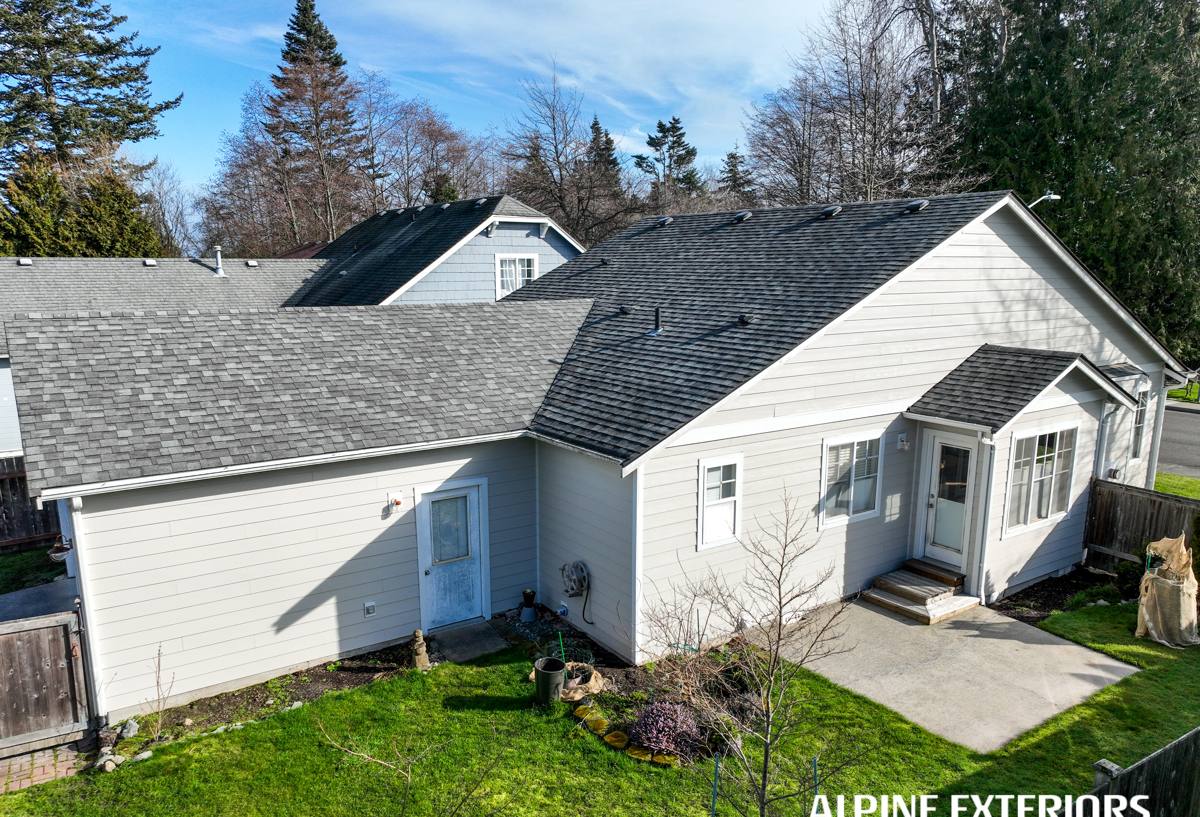
What the Local Climate Actually Does to Siding
Salt Air
Proximity to Bellingham Bay means a steady, low-level exposure to salt-laden moisture in the air. Salt is hygroscopic — it pulls moisture toward itself — which means painted wood and some composite sidings can hold dampness longer in coastal-adjacent neighborhoods than they would further inland. Over years, that shows up as paint failure, soft spots, and accelerated rot at seams and butt joints.
Driving Rain
Whatcom County doesn't just get a lot of rain — it gets a lot of wind-driven rain, which behaves differently than a straight vertical downpour. Driving rain finds its way behind poorly lapped siding, under weak caulk joints, and into any gap that a calmer climate would never expose. Siding systems and installation details that would hold up fine in a drier region can fail here simply because the water pressure and angle are different.
Moss and Sustained Dampness
Bellingham's moss season isn't a few weeks — it's most of the year. Moss and algae thrive anywhere shaded siding stays damp for extended periods, particularly on north-facing walls and under eaves with limited sun exposure. Beyond the cosmetic green tinge, moss holds moisture against the surface of the siding, which accelerates whatever underlying deterioration is already happening.
Signs a Columbia Home Needs Siding Attention
Most siding problems don't announce themselves with a hole in the wall. They show up as smaller signals that are easy to write off as cosmetic. Worth checking for:
- Paint that's peeling, bubbling, or needing repainting more often than it used to
- Soft or spongy spots when you press on siding, especially near the bottom courses and around window trim
- Visible warping, buckling, or gaps between siding boards or panels
- Persistent moss or algae staining that comes back shortly after cleaning
- Musty smell or discoloration on interior walls that back up to exterior siding
- Rising utility bills that suggest the wall assembly isn't insulating or sealing the way it should
Any one of these on its own might be minor. Several at once usually means the siding system as a whole is past the point where patching makes sense.
Repair vs. Replacement
Not every issue calls for a full re-side, and we'll tell you that directly during an assessment. A cracked panel, damaged trim board, or isolated water intrusion point can often be repaired without touching the rest of the wall — as long as the underlying material and house wrap are still sound. The harder call is when the siding is original wood, older composite, or a lower-grade product that's simply reached the end of its service life across the board. In that case, chasing individual repairs year after year usually costs more over time than one properly done replacement.
| Situation | Repair Usually Makes Sense | Replacement Usually Makes Sense |
|---|---|---|
| Damage extent | Isolated to a few boards or panels | Widespread across multiple walls or elevations |
| Underlying material condition | House wrap and sheathing still sound | Moisture has reached sheathing or framing |
| Siding age | Newer material, still within expected lifespan | Original wood or aging composite, decades old |
| Recurring issues | First occurrence, clear cause | Same problem area repaired more than once |
| Long-term plan | Selling soon or budget-limited this cycle | Planning to stay, want to stop the maintenance cycle |
Why We Install James Hardie and Nothing Else
We're a Hardie-only siding contractor, and in a climate like Whatcom County's, that's not a marketing position — it's a practical one. James Hardie fiber cement is engineered specifically to resist moisture absorption, and the HZ5 product line is formulated for the wetter, more freeze-thaw-variable climates found here in the Pacific Northwest. It doesn't rot, it doesn't feed moss and algae the way wood fiber does, and it's non-combustible, which matters more each year as wildfire smoke seasons stretch longer even in western Washington.
The factory-applied ColorPlus finish is a real advantage in a neighborhood like Columbia, where salt air and constant dampness are hard on field-applied paint. ColorPlus is baked on under controlled conditions and backed by its own finish warranty, so you're not repainting every 5-8 years the way you often are with site-painted wood or fiber cement that's been field-finished. Combined with Hardie's substrate warranty, you get a siding system built for exactly the conditions this part of Bellingham deals with — not a general-purpose product that happens to be sold here too.
We don't install vinyl, LP SmartSide, cedar, or primed spruce, and we're upfront about why: each of those has real trade-offs in sustained-moisture, salt-air environments — whether that's moisture-driven swelling at cut edges, ongoing repainting and caulking maintenance, or vinyl's tendency to warp and fade under UV and temperature swings — that we don't want to put our name behind long-term. Hardie is what we've standardized on because it holds up to inspection years later, not just at installation.
What Correct Installation Looks Like
Fiber cement performs the way it's engineered to only when it's installed correctly. That means proper flashing and weather-resistive barrier detailing behind the siding, correct fastener type and placement, proper clearances at grade and roof lines, and factory-specified caulking and joint treatment. In a driving-rain climate, installation details at seams, corners, and penetrations matter as much as the siding material itself — most siding failures we see in this area trace back to installation shortcuts, not the product.
Beyond Siding: Roofing, Windows, and Decks
Siding rarely fails in isolation. A roof that's shedding water poorly, windows with failed seals, or a deck that's trapping moisture against the house all interact with how the siding performs. We handle roofing, window replacement, and deck work alongside siding for that reason — when we're on a Columbia property doing an exterior assessment, we're looking at the whole envelope, not just the wall cladding. That matters most at transition points: where roofline meets siding, where window trim meets wall, where a deck ledger board attaches to the house. Those are the spots most likely to leak, and they're easiest to get right when one crew is responsible for how they all tie together.
Why a Local Crew Matters Here
Whatcom County's weather isn't generic Pacific Northwest weather — the combination of bay-adjacent salt exposure, wind direction off the water, and a moss season that runs most of the calendar year is specific to this stretch of coastline. A crew that works this area regularly knows which walls in a Columbia home are going to take the worst of the driving rain, which north-facing sections need extra attention for moss and algae, and how local permitting and inspection processes work. That local knowledge shows up in the details — flashing choices, ventilation, where extra care goes into a job — more than it shows up in any sales pitch.
What to Expect From an Estimate
A siding assessment on a Columbia home starts with a walk-around: checking for soft spots, moisture entry points, moss buildup, and how the current siding is holding up at seams, corners, and trim. From there we talk through whether repair or full replacement makes sense, what a Hardie system would look like on your home — lap siding, panel, or a mix with trim accents — and give you a straightforward cost range based on square footage and complexity, not a number pulled out of thin air.
| Cost Factor | Why It Matters |
|---|---|
| Home size and wall complexity | More corners, dormers, and trim details mean more labor |
| Current siding removal | Tear-off and disposal of old material adds time and cost |
| Underlying damage | Rotted sheathing or framing found during tear-off requires repair before new siding goes on |
| Siding profile chosen | Lap, shingle-style panel, and board-and-batten vary in material and install time |
| Trim and accent work | Window and door trim, fascia, and accent bands add detail labor |
Questions Worth Asking Any Siding Contractor
- Are they licensed and insured to do exterior work in Washington State?
- Do they carry manufacturer certification for the siding product they're proposing?
- Will they put the flashing, house wrap, and installation details in writing, not just the siding brand?
- Do they inspect and address what's under the siding, not just what's over it?
- Is the warranty backed by both the manufacturer and the installer, or just one of them?
If your Columbia home's siding is showing wear, holding onto moss longer than it should, or you're just ready to stop patching and deal with it properly, we'll come take a look and give you a straightforward, no-pressure estimate — use the form below to get started.