 Bellingham
 Blaine's Exterior Climate Is Tougher Than It Looks
Blaine sits about as far northwest as you can get in Washington without crossing into Canada, tucked along Semiahmoo Bay and Drayton Harbor. It's a beautiful spot to own a home, but the same water that makes the views worth it also makes the exterior of a house work harder than it would a few miles inland. Homes here deal with a near-constant onshore breeze off the bay, long stretches of low-pressure systems rolling in off the Strait of Georgia, and a wet season that can stretch from October well into May.
None of that is unusual for Whatcom County. What's different about Blaine specifically is the combination of proximity to open water and exposure. Homes closer to the shoreline get more direct salt-laden air, more wind-driven rain hitting siding at an angle instead of falling straight down, and less tree cover to break up the wind than you'd find in wooded areas around Bellingham or Ferndale. Homes set back from the water still deal with the same rain totals and the same shaded, damp conditions that keep moss and algae established most of the year.
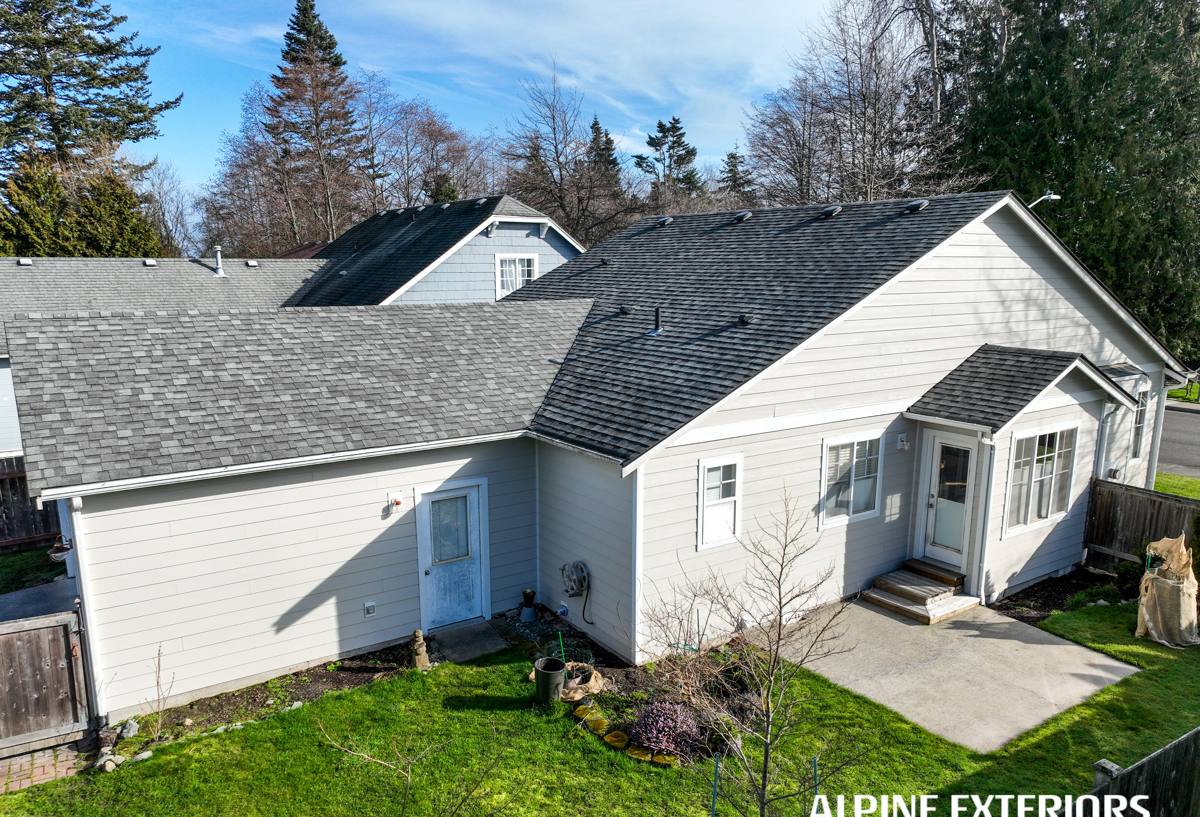
What Salt Air Actually Does to a House
Salt air doesn't need to be blowing off the ocean itself to matter — brackish water like Semiahmoo Bay and Drayton Harbor still carries enough salt to accelerate wear on exterior materials. A few things happen over time:
- Metal fasteners, flashing, and trim hardware corrode faster than they would inland, especially if they're not marine-grade or properly coated.
- Painted wood surfaces chalk and fade quicker, and paint adhesion breaks down sooner near a coastline.
- Caulk and sealant joints dry out and crack faster under the combination of salt exposure and UV.
- Any siding material with a tendency to swell or absorb moisture gets a head start on failure, because salt air keeps humidity elevated even on days without rain.
None of this means a home near the bay is doomed to expensive repairs. It means the materials and installation details matter more here than they would in a drier, inland climate — there's less room for shortcuts.
Driving Rain and Wind-Driven Moisture
"Driving rain" isn't just a lot of rain — it's rain pushed sideways by wind, which changes how it interacts with a wall. Instead of running straight down and shedding off, wind-driven rain gets forced up under laps, into gaps around trim and penetrations, and into any seam that isn't properly lapped or sealed. Blaine's open exposure to weather systems coming across the water makes this a bigger factor than it is in more sheltered parts of Whatcom County.
This is why installation quality matters as much as the siding product itself. Correct flap and lap sequencing, properly flashed windows and doors, and weather-resistant barrier detailing behind the siding are what actually keep a wind-driven rain event from becoming a moisture problem inside the wall cavity. A good product installed with shortcuts will still leak. A good product installed correctly, on a home exposed to this kind of weather, is what actually holds up over decades.
The Long Moss Season
Moss and algae growth is a fact of life anywhere in Western Washington, but the combination of shade, humidity, and mild temperatures around Blaine keeps conditions favorable for growth most of the year — not just the wet months. North-facing walls, areas under eaves and overhangs, and anything close to landscaping or tree cover are the spots that show it first.
Moss itself doesn't necessarily damage most modern siding materials directly, but it holds moisture against the surface longer, which is where problems start. On materials that absorb water or swell — like untreated wood, some engineered wood products, or siding with compromised paint or sealant — sustained moisture contact is what leads to soft spots, rot, and premature failure. On a material that doesn't absorb water, moss is mostly a cosmetic and cleaning issue rather than a structural one.
Why We Install Only James Hardie Fiber Cement
We made the decision years ago to install James Hardie fiber cement siding exclusively, and nothing about coastal exposure has changed our mind — if anything, it's reinforced it. Fiber cement is a cement-based composite, not wood or wood-derived, so it doesn't absorb and swell the way engineered wood products can. That matters directly in a moss-heavy, high-moisture environment like Blaine's, where sustained contact with damp organic growth is a regular condition rather than an occasional one.
A few specifics that matter for this area:
- Non-combustible core — not a coastal-specific benefit, but relevant given wildfire smoke and ember exposure has become a broader Pacific Northwest concern in recent summers.
- ColorPlus factory finish — a baked-on finish applied under controlled conditions, which holds up better against UV and salt-air fading than field-applied paint, and reduces how often the exterior needs to be repainted.
- HZ5 product engineering — Hardie's HZ5 line is formulated for wetter, more variable climates, which is the right specification for Whatcom County's coastal zones.
- Dimensional stability — fiber cement doesn't expand and contract with moisture the way wood-based products can, which keeps joints, caulking, and paint lines intact longer.
We don't install LP SmartSide, vinyl, cedar, primed spruce, or other fiber cement brands like Cemplank or Allura. That's not a knock on every homeowner's choice of exterior — it's a professional standard we hold ourselves to. Products like engineered wood siding can perform reasonably well in drier, more sheltered locations, but we're standing behind our installations in a place where salt air, driving rain, and a long moss season are the norm, not the exception. We'd rather install one product we trust completely than offer several we'd have reservations about recommending here specifically.
How Hardie Compares to Common Alternatives in This Climate
| Material | Moisture Behavior Near Water | Maintenance in Moss-Prone Areas | Typical Refinishing Cycle |
|---|---|---|---|
| James Hardie fiber cement | Does not absorb/swell; dimensionally stable | Occasional wash; finish resists staining | Repaint not required for the ColorPlus warranty period |
| Engineered wood siding | Can swell or degrade if edges/seams aren't sealed and maintained | More sensitive to sustained moisture and moss contact | Repaint typically needed sooner near coastal exposure |
| Vinyl siding | Doesn't absorb moisture, but seams and fasteners are common leak points | Can trap moss/algae in overlaps; UV fading over time | Not repaintable in the traditional sense; replacement when damaged |
| Cedar/wood siding | Absorbs moisture readily; needs consistent sealing | High — most vulnerable to sustained moss/moisture contact | Frequent refinishing, especially near salt air |
It's Not Just Siding — Roofing, Windows, and Decks Take the Same Beating
A home's exterior is a system, and in a place like Blaine, every component of that system is dealing with the same salt air, wind-driven rain, and moss exposure. We handle roofing, windows, and decks alongside siding for exactly that reason — it's hard to get a watertight, long-lasting exterior when different trades are handling flashing details, window integration, and deck ledger connections without coordinating with each other.
- Roofing — proper flashing at valleys, chimneys, and roof-to-wall transitions is where most coastal leaks actually originate, not the field of the roof itself.
- Windows — correct flashing integration between the window and the siding's weather-resistant barrier is critical in wind-driven rain conditions; a good window installed without proper flashing will leak regardless of the siding around it.
- Decks — ledger board attachment and flashing where a deck meets the house is one of the most common failure points on coastal homes, since it's a horizontal moisture trap right against the structure.
Why a Local Crew Matters Here
Blaine's conditions aren't identical to Bellingham's, and they're not identical to inland Whatcom County either. A crew that works across this region regularly knows which walls on a given lot orientation are going to take the worst of the wind-driven rain, where moss is going to establish first, and how much more attention flashing and sealant details need on a home that's exposed to open water versus one that's sheltered by trees or terrain.
That local knowledge shows up in small decisions — how tight to run fastener spacing, which trim details get extra sealant, where ventilation needs extra attention — that don't show up on a spec sheet but matter a lot over the life of the siding. It also means someone is nearby and familiar with your home if a question comes up years down the road, not a crew that installed once and moved on to a different region.
What to Look For When Planning a Siding Project in Blaine
- Confirm the siding product is rated appropriately for coastal/wet climate exposure, not a general-purpose specification.
- Ask how flashing will be handled at windows, doors, and any roof-to-wall intersections — this is where most real-world leaks start.
- Check that fasteners and hardware are corrosion-resistant, not standard-grade, given the salt air.
- Ask about the factory finish versus field-applied paint, and what warranty coverage applies to each.
- Get a clear answer on how moss and algae growth will be addressed — both in product choice and in ongoing care.
- Make sure whoever is doing the work is pulling permits and following manufacturer installation specs, not just "how we've always done it."
Getting Started
If you own a home in Blaine and you're noticing moss buildup, fading, soft spots, or just want an honest assessment of how your current siding is holding up against the bay's climate, we're happy to take a look. We'll walk the exterior with you, point out what we actually see — not a sales pitch — and explain what a James Hardie installation would involve for your specific home. Reach out for a free, no-pressure estimate using the form below.