 Bellingham
 Siding in Sudden Valley: A Different Set of Conditions Than In-Town Bellingham
Sudden Valley sits along the shore of Lake Whatcom, tucked into forest and hillside a short drive outside Bellingham proper. It's a different microclimate than the flatter, more open parts of Whatcom County. The lake keeps humidity elevated for longer stretches of the year, the tree canopy holds moisture against exterior walls even after a storm has passed, and the terrain funnels wind and rain in ways that a lakeside or hillside lot experiences differently than a similar house a few miles away. If you own a home in Sudden Valley, your siding is doing more work than the label on the box would suggest.
We've worked on homes throughout Bellingham and Whatcom County long enough to know that a "one size fits all" approach to exterior work doesn't hold up out here. Homes in Sudden Valley face a mix of driving rain off the lake, a moss season that can run six months or longer under tree cover, and the kind of persistent dampness that shortens the life of the wrong siding material. This page walks through what that means for your home and how we approach siding, roofing, windows, and decks for houses in this part of the county.
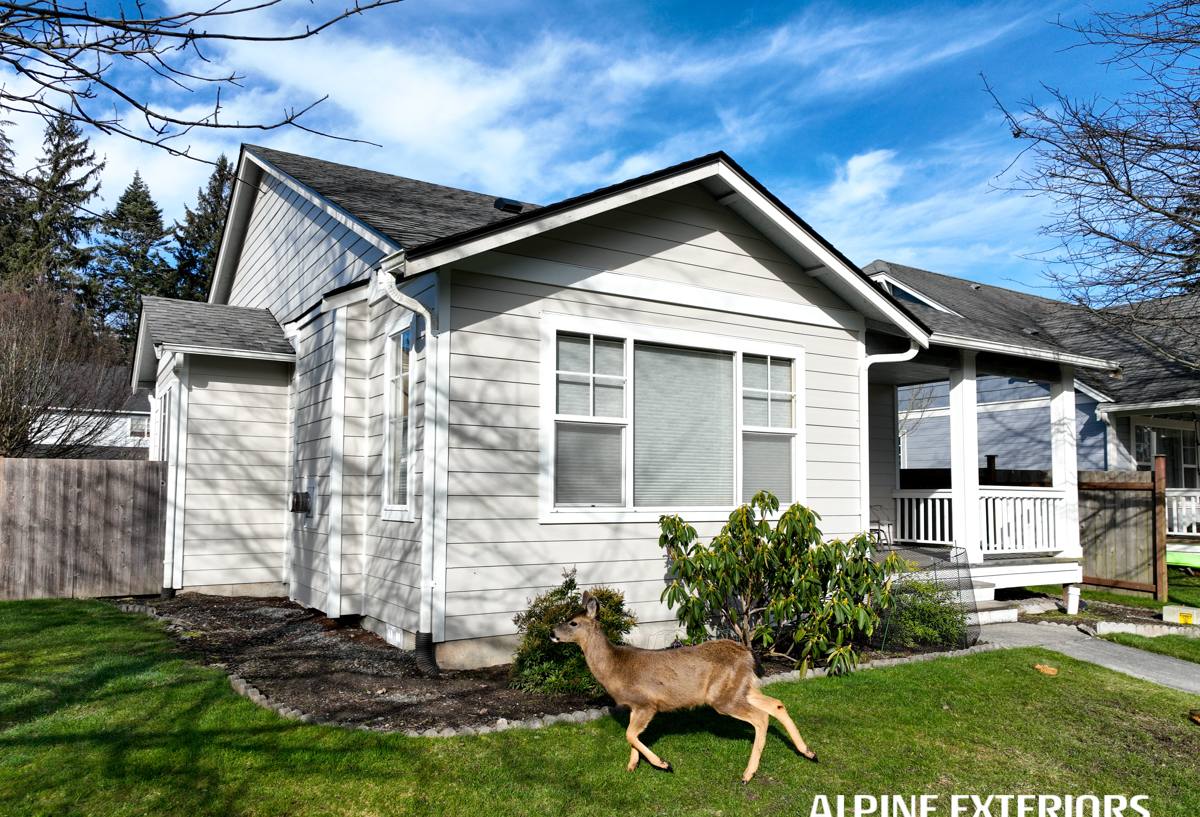
What the Sudden Valley Climate Actually Does to a House
Moisture That Doesn't Dry Out Fast
Coastal Pacific Northwest weather is wet, but Sudden Valley's tree cover and proximity to the lake add another layer to that. Shaded north and west-facing walls can stay damp for days after a rain event ends, especially heading into fall and winter. That's exactly the environment where wood-based sidings — cedar, primed spruce, and similar products — struggle. Sustained moisture exposure is what drives rot, cupping, and paint failure in those materials, and it's a big part of why we don't install them anymore.
A Long Moss and Algae Season
Shade plus moisture equals moss, and Sudden Valley gets plenty of both. Moss and algae growth on siding isn't just cosmetic — it holds water against the surface longer than bare siding would, which accelerates whatever moisture-related wear the material is already prone to. A siding product that resists moisture absorption at the material level, rather than relying purely on paint film to keep water out, holds up dramatically better under these conditions.
Driving Rain and Wind Exposure
Depending on where a lot sits relative to the lake and the surrounding ridgelines, wind-driven rain can hit siding at an angle rather than falling straight down, working its way into laps, seams, and trim joints that wouldn't see the same pressure in a more sheltered spot. Correct flashing details and lap coverage matter more here than they would on a calm, open lot — and that's an installation issue as much as a material one.
Why We Install Only James Hardie Fiber Cement
We used to get asked why we don't offer vinyl, LP SmartSide, Cemplank, Allura, or cedar anymore. The honest answer is that after years of siding work across Whatcom County — including plenty of shaded, damp lots like the ones common in Sudden Valley — we made a decision to standardize on one product system rather than sell whatever a homeowner might request. Here's the reasoning, product by product.
Vinyl Siding
Vinyl is inexpensive and low-maintenance in the sense that it never needs painting, but it's a thin plastic product that expands and contracts with temperature swings, can crack in impacts, and has a ceiling on how long it looks good — it fades and chalks over time, and it can't be repainted to refresh it. In a wooded, damp setting, vinyl also tends to trap moisture behind it if the water-resistive barrier and installation aren't done exactly right, since it isn't a breathable or moisture-managing material itself.
LP SmartSide, Cemplank, and Allura
LP SmartSide is an engineered wood product — it's an improvement over old-style hardboard, but it's still wood-based, meaning it depends on intact factory sealant and careful field-cut treatment to keep moisture out at every edge. Cemplank and Allura are fiber cement, similar in concept to what we install, but we standardized on one manufacturer's system — with one warranty structure, one factory finish process, and one set of engineering specs for our climate zone — rather than juggling multiple product lines with different installation requirements and warranty terms.
Cedar and Primed Spruce
Real wood siding has a classic look that a lot of homeowners still want, and there's nothing wrong with that preference. But wood is the most moisture-sensitive option on this list, and Sudden Valley's shaded, humid microclimate is close to a worst-case scenario for it. Wood siding here needs vigilant maintenance — recaulking, repainting, and moisture monitoring — to avoid rot, and even then, the lifespan tends to be shorter than homeowners expect going in.
What Hardie Gets Right for This Climate
James Hardie fiber cement is non-combustible, dimensionally stable across temperature and moisture swings, and comes factory-finished with ColorPlus Technology — a baked-on finish that resists fading and chipping far better than field-applied paint. Hardie also engineers specific product lines (HZ5 for our region) for cold, wet climates, which matters when you're dealing with the kind of sustained dampness Sudden Valley sees for a good chunk of the year. It's not a miracle material — installed poorly, any siding will fail — but installed to spec, it's the product we're willing to put our name behind.
Siding Product Comparison for This Climate
| Material | Moisture Behavior | Maintenance | Typical Lifespan Here |
|---|---|---|---|
| James Hardie Fiber Cement | Highly moisture-resistant, dimensionally stable | Occasional wash; factory finish holds color | 30+ years installed to spec |
| Vinyl | Doesn't absorb water, but can trap moisture behind it if installed wrong | Low, but can't be refreshed once faded | 15-25 years |
| LP SmartSide / Engineered Wood | Moisture-sensitive at cut edges and seams | Field sealing of cut edges, periodic repainting | 15-20 years, shorter if maintenance lapses |
| Cedar / Primed Spruce | Most moisture-sensitive; prone to rot in shaded/damp lots | High — regular painting, caulking, inspection | 10-20 years, highly maintenance-dependent |
Roofing, Windows, and Decks for Sudden Valley Homes
Roofing
A roof under tree cover deals with moss, needle and leaf debris in valleys, and shaded sections that dry out slower after rain. Regular gutter and valley maintenance matters more here than on an open lot, and we look at ventilation and moisture escape as part of any roofing project, not just the shingles themselves.
Windows
Older or poorly sealed windows in a persistently damp environment are a common source of condensation and eventual frame damage. When we replace windows, proper flashing integration with the new siding is as important as the window unit itself — a good window installed with bad flashing details will leak eventually, especially in a wind-driven rain environment.
Decks
Outdoor living space in Sudden Valley means building for shade and moisture from day one. Decking material choice, proper ledger flashing, and drainage away from the house all matter more when a deck sits under tree cover for much of the year rather than baking dry in full sun.
What a Siding Project Looks Like Here
Assessment
We start by looking at the specific exposure of your home — which walls face the lake or catch prevailing wind, which sides sit in constant shade, and where existing moss, staining, or moisture damage tells us something about how water is currently moving around your house.
Moisture Management Details
Behind the siding, correct water-resistive barrier installation, flashing at every window and door, and proper lap coverage matter as much as the siding material itself. This is where a lot of siding failures actually originate — not from the product, but from shortcuts in details you can't see once the job is finished.
Installation to Manufacturer Spec
James Hardie's warranty is tied to installation being done to their published specifications — proper fastening, clearances, and caulking. We install to that standard as a baseline, not an upsell.
A Practical Checklist Before You Commit to a Siding Project
- Walk your home's exterior and note which walls stay damp or mossy longest after rain
- Check for soft spots, staining, or paint failure near ground level and under eaves
- Ask any contractor you're considering which specific siding product they install and why
- Confirm whether flashing and water-resistive barrier work is included, not just the siding panels
- Ask what warranty covers the material versus the installation labor, and who backs each
- Get a clear, written scope before work starts — verbal promises don't hold up later
Why a Local Crew Matters in Sudden Valley
Sudden Valley isn't a subdivision you can treat like every other Bellingham neighborhood. The tree cover, the lake proximity, and the terrain all change how water behaves around a house compared to a more open lot closer to town. A crew that works across Whatcom County regularly — not just occasionally passing through — recognizes those differences on sight and builds the job around them instead of applying a generic approach and hoping it holds up through the next wet season.
We also know that access and staging can be different out here than on a standard in-town lot — driveways, tree clearance, and site logistics all factor into how a project gets planned and scheduled.
Get a Free, No-Pressure Estimate
If your Sudden Valley home is showing moss buildup, paint failure, soft siding, or you're just planning ahead for an eventual replacement, we're happy to come take a look and give you a straightforward assessment — no pressure, no sales script. Use the form below to request a free estimate.