 Bellingham
 Birch Bay's Exterior Reality: Salt, Wind, and Water
Birch Bay sits right on the water, and that changes what a house has to deal with compared to a home a few miles inland. Homes along the bay take on a combination most Whatcom County properties don't see all at once: salt-laden air off the water, wind-driven rain that hits siding sideways instead of straight down, and a long, damp moss season that runs from fall through spring. Any one of those is manageable. All three together, year after year, is what wears down exterior materials that weren't built for it.
We work throughout Bellingham and Whatcom County, and Birch Bay is one of the areas where we see the clearest difference between a house that was sided and roofed with the local climate in mind and one that wasn't. It shows up first in the details — caulk lines that have opened up, paint that's chalking or peeling on the windward side, fascia boards gone soft at the corners — long before it shows up as an obvious failure.
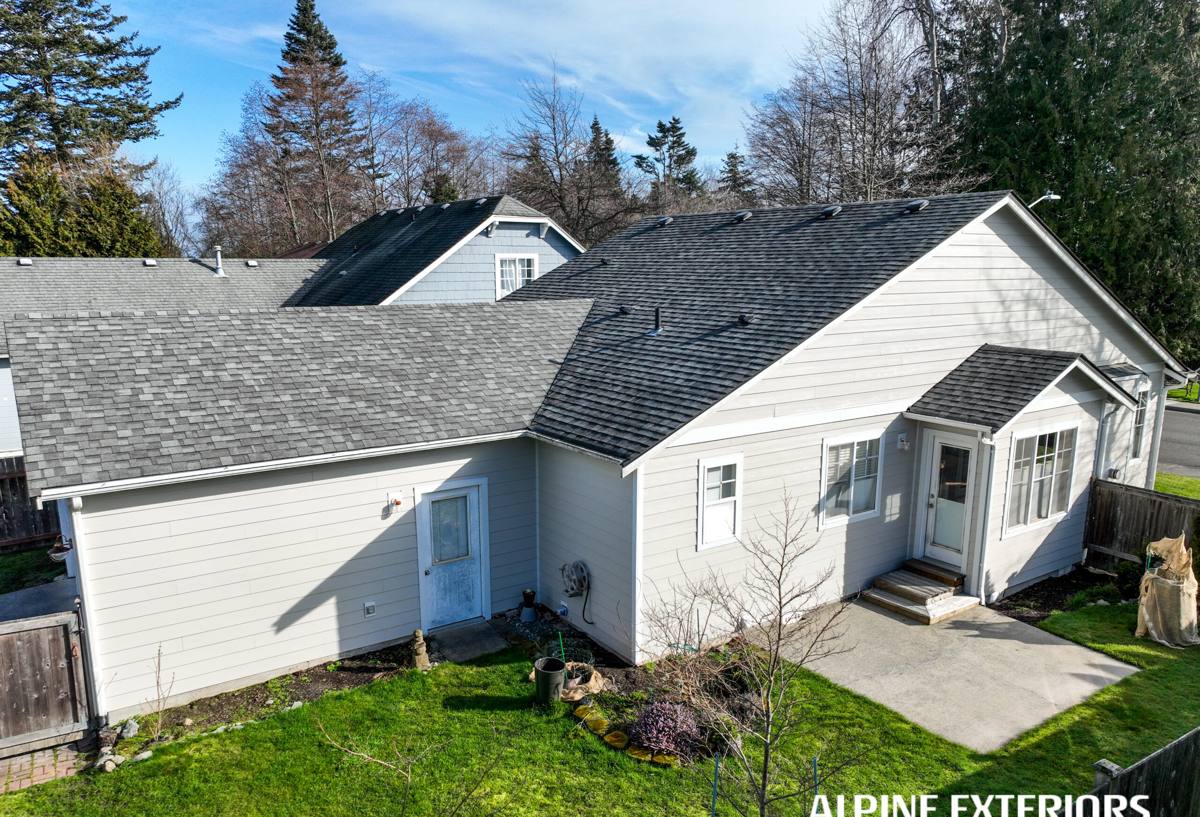
What Salt Air Actually Does to a House
Coastal salt air is corrosive to a lot of building materials, not just metal. It accelerates the breakdown of exterior paint films, degrades certain caulks and sealants faster than inland exposure would, and can contribute to premature corrosion on fasteners, flashing, and hardware that isn't rated for it. Homes directly along the bay or with an open water-facing exposure get the worst of it; homes set back or shielded by trees and terrain get a milder version, but it's still there.
This is one of the reasons material choice matters more in Birch Bay than it does in a sheltered inland neighborhood. A siding product that's marginal in a normal Whatcom County location can fail noticeably faster right on the water.
Where We See It First
- Caulk joints around windows, doors, and trim opening up or shrinking away from the substrate
- Paint film breakdown on south- and west-facing, water-exposed walls
- Corrosion streaking near fasteners, flashing edges, and hose bibs
- Softening or swelling at siding butt joints and cut ends that weren't properly sealed
Driving Rain and Wind-Driven Water Intrusion
Birch Bay gets exposed to weather off the Strait in a way that pushes rain sideways during storms, not just straight down. That matters enormously for how siding is installed. Any siding system — including the best products on the market — depends on correct lap, flashing, and drainage-plane detailing to shed wind-driven rain instead of letting it work behind the cladding. In a sheltered inland yard, a minor installation shortcut might never get tested by the weather. On an exposed Birch Bay lot, it gets tested every winter.
This is why we treat installation quality as inseparable from material quality. A top-tier siding product installed with sloppy flashing details will still let water in. A correctly detailed water-resistive barrier, properly lapped siding courses, and flashing at every horizontal transition are what actually keep wind-driven rain out of the wall assembly — the siding material is the visible layer, but the system behind it is what does the real work.
The Long Moss Season
Whatcom County's damp, mild climate keeps moss and algae growth active for most of the year, and shaded or north-facing exterior surfaces in Birch Bay — especially anything close to trees or with limited sun exposure — can stay wet enough, long enough, to support ongoing growth. On roofs, that means accelerated wear on shingles and moss lifting granules or working under laps. On siding and trim, it means a persistent green or black film that traps moisture against the surface and keeps it from drying out between rain events.
Regular gutter and roof maintenance, appropriate ventilation, and siding that resists moisture absorption all help here. It's a cumulative problem — a house that goes a few years without attention to moss control on the roof and shaded siding areas can end up with real moisture damage that wasn't obvious until it was serious.
Why We Only Install James Hardie Fiber Cement
We made a decision as a company to install James Hardie fiber cement siding exclusively — not vinyl, not LP SmartSide, not primed spruce or cedar, not other fiber cement brands. That decision matters even more in a place like Birch Bay, because the products we don't install all have real vulnerabilities in exactly the conditions this area produces.
Vinyl siding can warp and distort under sustained wind and temperature swings, and its seams and J-channels give wind-driven rain more opportunities to find a way behind the cladding. Wood-based products — whether primed spruce, cedar, or engineered wood siding like LP SmartSide — are organic materials at their core, and organic materials are what moss, algae, and rot are built to exploit. In a climate with this much sustained moisture and a long damp season, that's a real maintenance burden, not a hypothetical one.
James Hardie fiber cement is non-combustible and doesn't rot, because it isn't wood. It's engineered from cement, sand, and cellulose fibers, and Hardie's HZ5 product line is specifically formulated for cold, wet climates like ours — Whatcom County falls squarely in that engineering zone. The factory-applied ColorPlus finish is baked on under controlled conditions, which gives it better adhesion and UV/moisture resistance than field-applied paint, and it comes with a real transferable warranty backing it up. That combination — a material that doesn't feed moss and rot, a finish engineered to hold up to sun and salt air, and installation done to Hardie's own climate-specific specifications — is why we standardized on it rather than offering a menu of options with very different long-term outcomes.
Material Comparison for Coastal Whatcom County Conditions
| Material | Moisture/Rot Resistance | Salt Air Durability | Long-Term Maintenance |
|---|---|---|---|
| James Hardie Fiber Cement (HZ5) | Excellent — non-organic, engineered for wet climates | Strong; factory finish resists chalking/fading | Low — no repainting cycle for the life of ColorPlus finish |
| Vinyl Siding | Doesn't rot, but seams allow water intrusion | Can become brittle; color fades over time | Moderate — warping/cracking replacement over time |
| Wood / Primed Spruce / Cedar | Poor to moderate — organic, feeds moss and rot | Weak — accelerated weathering near salt air | High — regular painting, caulking, moss treatment |
| LP SmartSide / Engineered Wood | Better than raw wood, still moisture-sensitive at cuts and edges | Moderate — dependent on maintained finish | Moderate to high — edge sealing and finish upkeep |
Roofing, Windows, and Decks in the Same Climate
Siding is only part of the picture on a Birch Bay property. We also handle roofing, window replacement, and deck construction, and all four trades face the same underlying climate challenges — they just show up differently.
- Roofing: moss control, proper ventilation, and flashing details at every penetration and valley matter as much as the shingle or material choice itself.
- Windows: flashing and integration with the siding system is where most window-related water intrusion actually originates — the window unit itself is rarely the failure point.
- Decks: ledger flashing and proper drainage away from the house are critical where a deck meets a wall that's already dealing with wind-driven rain exposure.
Because these systems intersect — a deck ledger ties into siding, a window sits inside a wall's water-resistive barrier, a roof's drainage affects how much water runs down the walls below — having one crew that understands how they all fit together reduces the gaps where problems start.
Why a Local Crew Matters Here
Birch Bay's exposure isn't uniform. A lot facing open water gets weather that a lot two streets back, shielded by a rise in terrain or a stand of trees, simply doesn't see to the same degree. Knowing the difference — and adjusting flashing details, fastener choices, and even siding profile recommendations accordingly — comes from having worked on homes in this specific area, not from a generic regional playbook.
We're based in Whatcom County, and we see the same coastal conditions, the same moss patterns, and the same wind exposure on our own properties and projects. That local familiarity is part of what informs how we detail a job in Birch Bay differently than we might for a sheltered inland Bellingham lot.
What a Birch Bay Siding Project Involves
Before We Start
- Assess existing siding, sheathing, and water-resistive barrier condition, including any hidden moisture damage around windows, doors, and trim
- Evaluate exposure — direct water-facing walls typically need more attention to flashing and joint detailing than sheltered elevations
- Check moss and algae staining patterns on the existing structure as an indicator of persistent damp areas
During Installation
- Repair or replace any compromised sheathing before new siding goes up
- Install or verify a correct water-resistive barrier with proper lapping and taping
- Flash every window, door, and horizontal trim transition per manufacturer specifications
- Install James Hardie panels and trim to Hardie's fastening and clearance requirements, including ground clearance to reduce splash-back moisture
Cost Factors Specific to Birch Bay Properties
Every project is different, but a few factors tend to influence cost more in a coastal exposure like Birch Bay than they would inland:
| Factor | Why It Affects Cost Here |
|---|---|
| Extent of hidden moisture damage | Water-facing walls are more likely to have sheathing or framing repair needs behind old siding |
| Flashing detail complexity | Wind-driven rain exposure calls for more thorough flashing at every penetration, which adds labor |
| Site access and staging | Waterfront and bluff-adjacent lots can have more limited access than a standard inland lot |
| Existing material removal | Older wood or vinyl siding with moisture damage may require more extensive tear-off than sound existing material |
If you're weighing a siding, roofing, window, or deck project on a Birch Bay property, we're glad to take a look and talk through what your specific exposure and existing conditions call for. Reach out for a free, no-pressure estimate — there's a form right below.