 Bellingham
 Why We Only Install One Brand of Siding
Most siding contractors will install whatever a homeowner picks off a sample rack. We stopped doing that years ago. Every job we take on in Bellingham and the rest of Whatcom County goes on the house as James Hardie fiber cement siding, full stop. We don't carry vinyl, LP SmartSide, cedar, primed spruce, Cemplank, or Allura on the truck, and we're not shy about explaining why.
This isn't brand loyalty for its own sake. It's the result of watching how different siding materials actually hold up in this specific corner of the Pacific Northwest, where salt air off Bellingham Bay, long stretches of driving rain, and a moss season that can run eight months a year all work against a house at the same time. When we narrowed our product line to one, it was because the failure modes we kept seeing on other materials were predictable, and Hardie was the one product that consistently avoided them.
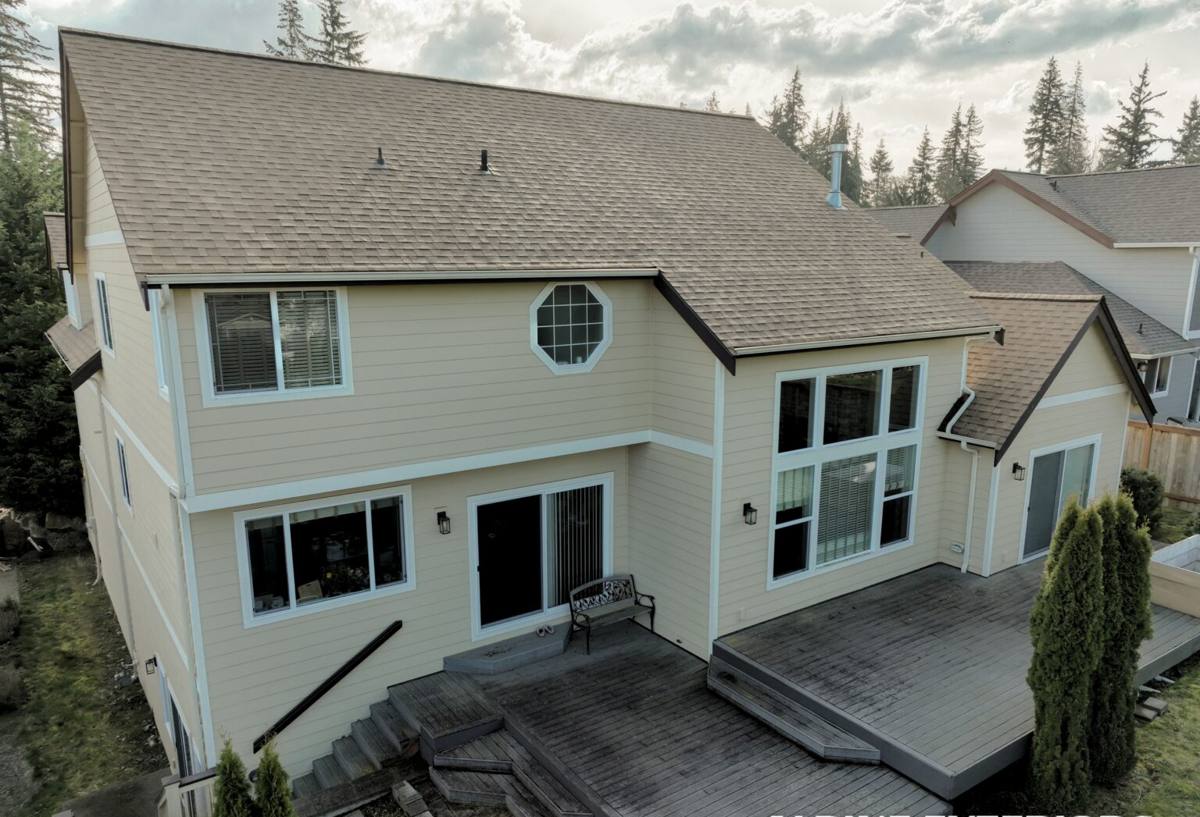
What Bellingham's Climate Actually Does to Siding
Whatcom County sits in a marine climate that's wetter and greener than most of the country, and that has real consequences for exterior building materials.
Moisture That Never Fully Leaves
Between fall and spring, Bellingham siding can go weeks without a truly dry day. Wood-based products absorb that moisture at cut edges, fastener holes, and anywhere the factory coating has been breached. Once moisture gets into the substrate, it doesn't get much chance to dry out before the next rain arrives.
Moss, Algae, and Organic Growth
Shaded north-facing walls, tree cover, and constant dampness make Whatcom County an ideal environment for moss and algae growth on siding. Porous or textured surfaces give these organisms something to grab onto; smooth, dense, factory-finished surfaces give them much less.
Salt Air Near the Bay
Homes closer to Bellingham Bay and the water deal with a low-grade salt exposure that accelerates corrosion on fasteners and trim, and works into any small crack or seam in a siding system faster than it would inland.
The Products We Don't Install, and Why
We get asked regularly why we won't quote vinyl or LP SmartSide alongside Hardie. Here's the honest version.
Vinyl Siding
Vinyl is inexpensive and easy to install, and it doesn't rot. But it's a petroleum-based product that expands and contracts significantly with temperature swings, which loosens fastening over time and lets it rattle or bow. It's also thin enough that it dents easily, and its color is baked into the material itself, so any UV fading is permanent and can't be touched up. In a wet, moss-prone climate, the seams and J-channels on vinyl also give moisture and organic growth plenty of places to collect.
LP SmartSide and Other Wood-Strand Products
LP SmartSide is an engineered wood product, meaning its core is still wood strand and resin, just treated and coated. It performs reasonably well when every cut edge is sealed and maintained on schedule, but that's a big "when." Any breach in the coating, whether from a missed caulk joint, a woodpecker, or normal settling, opens a path for moisture into a wood-based core. In a climate where houses see rain more often than not, we didn't want to bet a 30-year siding job on every homeowner keeping up with edge-sealing maintenance forever.
Cedar and Primed Spruce
Real wood siding looks great and has a long history in this region, but it demands the most maintenance of anything on this list: regular refinishing, vigilant caulking, and active moss and mildew control. It's also the most vulnerable to the rot that our rainfall totals eventually cause once maintenance lapses, which it always does at some point over a few decades of ownership.
Cemplank and Allura
These are also fiber cement products, and fiber cement as a category is the right call for this climate. Our reason for standardizing on Hardie specifically over these competitors comes down to consistency of factory finish, the depth of their climate-specific engineering for the Pacific Northwest, and warranty terms we're comfortable putting our name behind. It's less about the raw material and more about the manufacturing and finishing details underneath it.
What Fiber Cement Gets Right
Fiber cement siding is made from cement, sand, and cellulose fiber, cured under pressure into a dense, stable board. That composition is what makes it non-combustible, dimensionally stable across temperature and humidity swings, and resistant to insects and rot in a way that no wood-based product can match. It holds paint and factory finishes far longer than wood because it doesn't move the way wood does with seasonal moisture changes.
James Hardie didn't invent fiber cement, but it's built the most complete system around it for different regions and climates, and that system is what we're actually buying into.
Hardie's Climate Engineering for the Northwest
Hardie manufactures regional formulations under its HZ5 designation, engineered specifically for climates like ours that see extended wet seasons and moderate freeze-thaw cycling. The formulation and factory finish are matched to the moisture load a house here actually experiences, rather than a one-size-fits-all national product.
Product Lines We Use
- HardiePlank lap siding — the most common choice, available in several exposure widths and profiles, and the workhorse for most Bellingham homes.
- HardiePanel vertical siding — used for board-and-batten looks and modern facades.
- HardieShingle siding — a shingle profile for homes wanting a traditional coastal look without the maintenance of cedar shakes.
- HardieTrim — matching trim boards so the whole exterior envelope is fiber cement, not just the field siding.
ColorPlus Factory Finish
Most of what we install carries Hardie's ColorPlus finish, a multi-coat, baked-on color process applied at the factory under controlled conditions rather than sprayed or brushed on site. That finish resists fading and chipping far better than field-applied paint, and Hardie backs it with its own finish warranty separate from the substrate warranty.
Warranty Structure
Part of why we're comfortable standing behind one brand is that Hardie's warranty coverage is straightforward and transferable to a new owner if the home sells, which matters to buyers doing due diligence in a market like Bellingham's.
| Coverage | What It Applies To | Typical Term |
|---|---|---|
| Substrate (non-ColorPlus) | Cracking, rotting of the fiber cement board itself | 30 years, transferable |
| ColorPlus finish | Peeling, cracking, or fading of the factory finish | Separate finish warranty, transferable |
| Labor (contractor-backed) | Installation workmanship | Set by the installing contractor, not Hardie |
That labor line matters: the manufacturer's material warranty is only as good as the installation underneath it, which is why correct installation is its own topic.
Installation Sensitivity: The Part Homeowners Don't See
Fiber cement is unforgiving of shortcuts in a way vinyl generally isn't. Improper fastening, missed clearances above grade or roofing, unsealed butt joints, or the wrong caulk can all undermine the material's real-world performance regardless of how good the board itself is.
What Correct Installation Involves
- Maintaining Hardie's specified clearance between siding and grade, decks, and roof lines so water can't wick up into the board.
- Proper fastener type, spacing, and placement per Hardie's published installation instructions.
- Sealing and flashing every penetration, window, and door opening before siding goes on, not after.
- Using Hardie-approved caulk and touch-up paint at cut edges and joints, matched to the ColorPlus finish.
- Correct overlap and starter strip setup so the drainage plane behind the siding actually works.
Because this level of care is what separates a 30-year installation from a 10-year headache, we treat installation training as seriously as material selection. It's also why we won't quote a job where a homeowner wants to supply their own crew for a "material only" Hardie order.
Cost Factors Homeowners Should Weigh
Hardie costs more upfront than vinyl and is generally in a similar range to or somewhat above LP SmartSide, depending on the profile and finish chosen. The fair way to evaluate that gap is over the life of the siding, not just at the estimate stage.
| Factor | Vinyl | LP SmartSide | James Hardie |
|---|---|---|---|
| Upfront material cost | Lowest | Mid | Mid-to-higher |
| Maintenance burden | Low, but limited repair options | Moderate, edge-sealing required | Low with correct install |
| Moss/algae resistance | Moderate | Moderate | Higher, dense surface |
| Fire resistance | Combustible | Combustible | Non-combustible |
| Finish longevity | Fades, cannot repaint edges cleanly | Field or factory finish, coating-dependent | ColorPlus factory finish, long-lived |
Questions to Ask Any Siding Contractor
Whatever material a homeowner ultimately chooses, these are the questions worth asking before signing a contract:
- Is the installer factory-trained or certified on the specific product being installed?
- Does the written estimate specify fastener type, clearance details, and flashing approach, or just "siding installation"?
- Who backs the labor warranty, and for how long, separate from the manufacturer's material warranty?
- Will cut edges and joints be sealed with the manufacturer's specified products, and is that itemized in the bid?
- Can the contractor explain, specifically, how the chosen product handles this region's rain and moss exposure rather than giving a generic answer?
If you're weighing your options for a home in Bellingham or anywhere else in Whatcom County, we're glad to walk your house with you and give a straight answer about what we'd do and why. There's no pressure and no cost for a free estimate.