 Bellingham
 Blaine's Siding Takes a Different Kind of Beating
Blaine sits right up against Semiahmoo Bay and Drayton Harbor, just south of the Canadian border, and that location shapes what happens to a house's exterior over time. Homes here deal with salt-laden air blowing off the water, long stretches of driving rain during fall and winter storms, and a moss season that can run eight months or more in shaded, north-facing yards. Add in the humidity that settles over Whatcom County for much of the year, and you have an environment that finds every weak point in a siding system — a caulk joint that dried out, a nail that backed out, a corner where water has been sneaking behind the board for two winters without anyone noticing.
Siding repair in Blaine isn't just about matching a color or patching a hole. It's about understanding why that section failed in the first place and making sure the fix doesn't just cover the problem — it corrects it. A repair done without that understanding tends to fail again in a season or two, usually in the same spot.
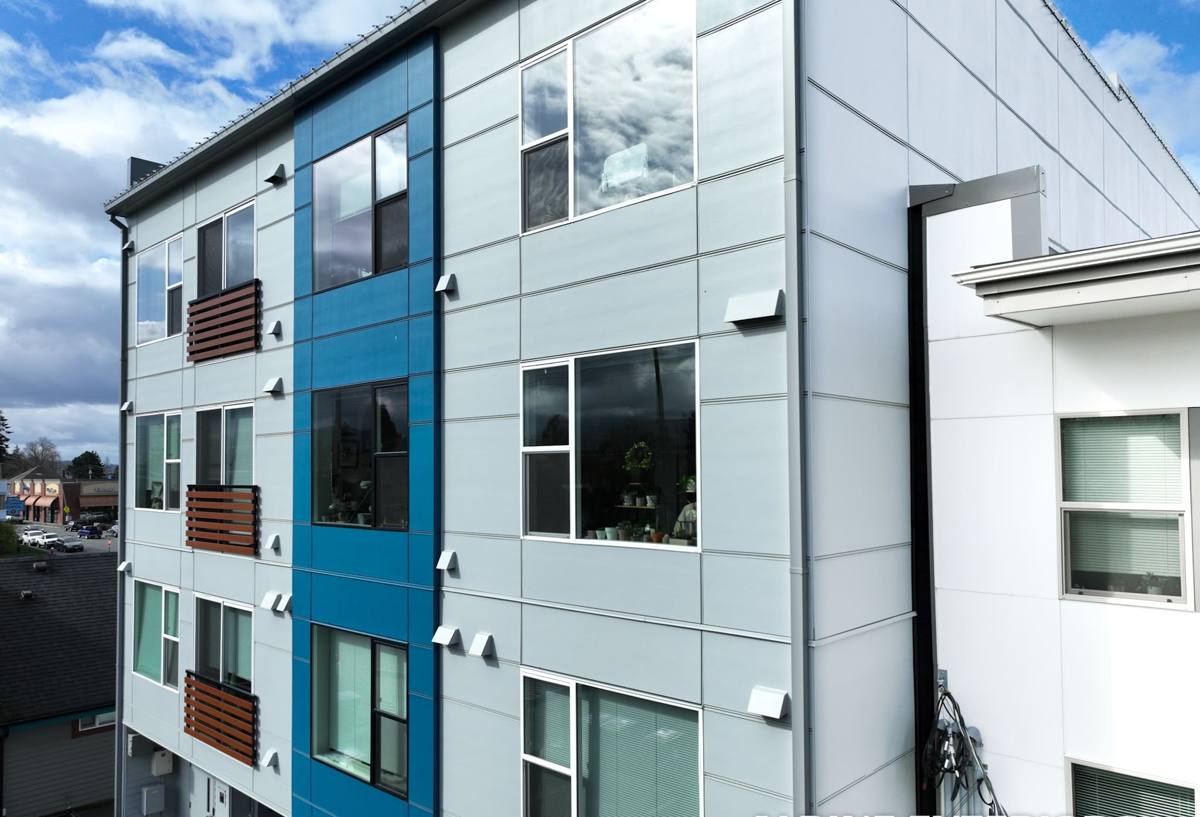
What Salt Air, Rain, and Moss Actually Do to Siding
Salt Air
Airborne salt from the bay accelerates corrosion on fasteners, flashing, and any exposed metal trim. On some siding materials it also breaks down surface coatings faster than a typical inland home would experience, which shows up as chalking, fading, or a rougher texture on the weather side of the house — usually the side facing the water or prevailing wind.
Driving Rain
Wind-driven rain doesn't just fall on siding, it gets pushed sideways into laps, seams, and butt joints. Where the original installation left gaps too tight or too loose, or where caulk has cracked with age, water finds its way behind the cladding. Once that starts, the damage is happening where you can't see it — in the sheathing and framing — long before it shows up as a soft spot or a stain on the surface.
Moss and Sustained Moisture
Whatcom County's wet season keeps shaded siding damp for days at a time, which is exactly what moss and mildew need to take hold. Beyond the cosmetic issue, moss holds moisture against the siding surface, extending the time any given board stays wet after a storm — and that extended wet time is what eventually breaks down materials that aren't built to handle it.
Signs Your Siding Needs Repair
Most siding repair calls in this area start with one of these observations. If you're seeing more than one at the same time, it's worth having it looked at before the next wet season.
- Soft or spongy spots when you press on the siding, especially near the bottom of walls or below windows
- Visible gaps, cracks, or separation at seams, corners, and trim joints
- Peeling or bubbling paint, or a chalky residue that wipes off on your hand
- Dark streaking, persistent moss, or green-black staining that returns after cleaning
- Warping, buckling, or boards that look wavy from an angle
- Rust streaks below nail heads or metal flashing
- Musty smell or visible staining on interior walls near an exterior wall
- Woodpecker holes or small animal damage that's opened a path for water
What a Correct Siding Repair Actually Involves
A repair that's done right in a climate like Blaine's goes beyond swapping a damaged board for a new one. It starts with figuring out how water got in, not just where it showed up.
1. Diagnose the Water Path, Not Just the Symptom
Stains and soft spots are often several feet away from where water is actually entering. A correct repair traces the path back — a failed kick-out flashing above a lower roofline, a missing or cracked sealant joint, a butt seam that was never properly lapped — before any new material goes up.
2. Check What's Behind the Siding
Once siding is pulled back, we look at the weather-resistive barrier and sheathing underneath. If there's rot, it gets cut out and replaced — patching over compromised sheathing just hides the problem for another year or two. This is also where we confirm flashing details are correct, since a lot of the water problems we see in this area trace back to flashing that was skipped or installed wrong during the original build.
3. Replace With Compatible, Climate-Appropriate Material
Whatever goes back on needs to handle the same salt air and rain the rest of the wall is exposed to. Matching material, thickness, and finish matters both for water performance and so the repair doesn't stand out.
4. Seal and Flash Properly This Time
Every seam, corner, and penetration gets sealed and flashed to shed water the way the original installation should have. This is the step that's most often shortchanged in a rushed patch job, and it's the step that determines whether the repair lasts.
Common Problems by Siding Material
What we find behind the siding — and how well a repair holds up — depends a lot on what material is on the wall to begin with. Here's what tends to show up on Blaine-area homes by material type.
| Material | Common Failure Mode Near the Coast | Repair Considerations |
|---|---|---|
| Vinyl | Cracks and warps from temperature swings; seams open and let wind-driven rain behind panels | Matching older, faded panels is difficult; underlying moisture damage is often worse than the visible crack suggests |
| Wood (cedar, primed spruce) | Rot at seams and lower courses; moss and mildew hold moisture against the surface | Repeated repainting and caulking needed; rot often extends further than the visible soft spot |
| LP SmartSide | Edge swelling if seams or cut ends aren't fully sealed and maintained | Repairs must fully seal all exposed edges to prevent recurring swelling |
| Fiber cement (James Hardie) | Caulk joint failure, fastener corrosion, or damage from impact rather than material breakdown | The board itself resists moisture and salt exposure well; repairs typically focus on sealant, flashing, and fasteners |
Repair or Replace? How We Help You Decide
Not every damaged section means the whole wall needs new siding, and not every visible problem can be fixed with a patch. A few factors drive that call:
- Extent of hidden damage — if rot has spread through multiple wall cavities, patching individual boards doesn't address the underlying problem
- Age and condition of the rest of the siding — repairing a 20-year-old wall that's failing elsewhere too is often a short-term fix
- Material availability — matching discontinued vinyl colors or weathered wood can be difficult; fiber cement's ColorPlus finish holds color more consistently over time, which helps with future patch matching
- Root cause — if the problem is a single flashing detail, a targeted repair can solve it permanently; if it's a systemic installation issue, a section-by-section approach will keep generating repair calls
We'll tell you honestly which situation you're in rather than defaulting to the more expensive answer.
Our Repair Process
- Inspection: We look at the damaged area and the surrounding wall, checking for related issues that aren't obvious from the ground.
- Diagnosis: We identify the actual water path or failure cause, not just the visible symptom.
- Scope and estimate: You get a clear explanation of what needs to happen and why, in plain language, before any work starts.
- Repair: Damaged material and any compromised sheathing are removed, the wall is properly flashed and sealed, and matching material is installed.
- Finish check: We confirm the repair blends with surrounding siding and that all seams and trim are properly sealed against the next storm.
Why We Use James Hardie for Repairs
When a repair calls for new material, we install James Hardie fiber cement — it's the only siding product we install, on repairs and full replacements alike. It's non-combustible, engineered for the wet, marine-influenced climate of the Pacific Northwest through Hardie's HZ5 product line, and finished with a factory-applied ColorPlus coating that holds up to sun and salt exposure better than field-applied paint. That matters specifically for repair work: a patch that fades or chalks faster than the surrounding wall becomes a visible mismatch within a couple of years. We won't put a short-term material on a wall just to save a step, even for a small patch.
Why Hiring a Crew That Already Works Blaine Matters
A contractor who works this area regularly already knows which parts of a house tend to fail first — the walls facing the water, the north sides that never fully dry out, the flashing details that get skipped in production-built homes. That local knowledge shortens the diagnosis step and helps avoid repeat repairs. It also means we're familiar with the permitting and inspection expectations for exterior work in this part of Whatcom County, so there aren't surprises partway through the job.
Beyond that, a crew based nearby can respond faster when a repair is urgent — a storm-damaged section that's actively letting water in shouldn't have to wait for a contractor to drive up from out of the area.
If you've got a section of siding in Blaine that's showing damage, staining, or softness, we'll come take a look, tell you honestly what's causing it, and give you a clear, no-pressure estimate for fixing it right. Use the form below to get started.