 Bellingham
 Blaine's Marine Climate and What It Does to a Roof
Blaine sits at the northern edge of Whatcom County, right along Drayton Harbor and Semiahmoo Bay, close enough to the water that salt-laden air is a daily fact of life on every roof in town. That air carries moisture and fine salt particles that settle on shingles, flashing, and fasteners year-round, and it doesn't take a storm to do it — a steady onshore breeze is enough. Combine that with the driving, wind-blown rain that rolls in off the Strait of Georgia during fall and winter, and you get a roof that's tested from more angles than most inland homes ever face.
Then there's moss. Blaine's mild, damp climate and the shade from mature evergreens common on Whatcom County lots create ideal conditions for moss and algae to take hold, especially on north-facing slopes and anywhere debris collects. Left unchecked, moss doesn't just look bad — it holds moisture against the roofing material, lifts shingle edges, and slowly works its way toward the deck underneath. A roof replacement in Blaine has to account for all three of these stressors at once: salt exposure, wind-driven rain, and a moss season that runs longer than it does in drier parts of the state.
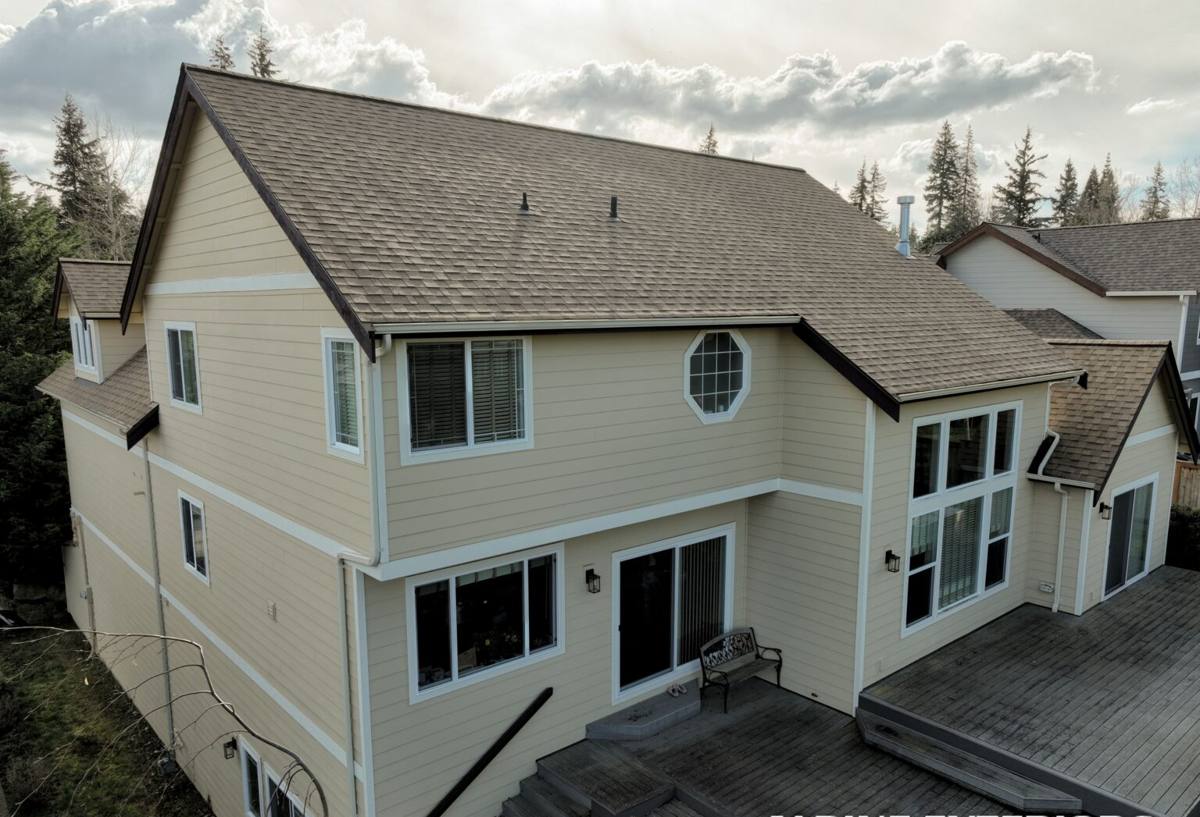
Repair or Replace? Signs It's Time for a New Roof
Not every roof problem calls for a full replacement, and a straight contractor will tell you that upfront. But there are signs that point past repair territory, particularly on a coastal roof that's been absorbing salt air and rain for fifteen-plus years.
What Usually Points to Replacement
- Granule loss heavy enough that you can see bare asphalt on multiple shingles, not just a few worn spots
- Shingles that are cupping, curling, or cracking across large sections of the roof, not isolated to one repair-sized area
- Soft or spongy decking found during an inspection, which usually means water has been getting in for a while
- Persistent moss growth that keeps returning within a season or two of cleaning, even after treatment
- Flashing around chimneys, vents, and valleys that's rusted, lifted, or was never properly sealed to begin with
- Daylight visible through the roof deck from inside the attic, or water stains on the underside of the sheathing
If your roof is showing one or two of these in a limited area, a targeted repair may still make sense. If it's showing several at once, or the roof is past its expected service life, replacement is usually the more honest recommendation — patching a roof that's failing systemically just delays a bigger repair bill later.
What a Correct Roof Replacement Involves in Blaine
A roof replacement is more than swapping old shingles for new ones. In a climate that pushes moisture from every direction, the details underneath the visible surface matter as much as the material on top.
Tear-Off and Deck Inspection
A full tear-off strips the roof down to the deck so it can actually be inspected, rather than covered over. Any soft, delaminated, or water-damaged sheathing gets replaced before anything new goes down. Skipping this step to save time is one of the most common shortcuts in the trade, and it's the one most likely to cause problems within a few years on a coastal home.
Underlayment, Flashing, and Ice-and-Water Protection
Given how much wind-driven rain Blaine sees, the underlayment and flashing details carry a lot of the actual weatherproofing load — arguably more than the shingles themselves. Self-adhered ice-and-water membrane at eaves, valleys, and around every penetration gives the roof a second line of defense when wind pushes rain up and under the shingle edge, which happens more often here than in sheltered inland areas. Flashing at chimneys, skylights, sidewalls, and roof-to-wall transitions needs to be installed correctly, not just caulked over — caulk is a maintenance item, not a substitute for proper flashing.
Ventilation and Moisture Control
A roof system that can't breathe traps moisture in the attic, which shortens the life of the decking and the shingles from underneath. Balanced intake and exhaust ventilation matters everywhere, but it's especially important in a marine climate where the air itself is already carrying more humidity than average. Correcting poor or blocked ventilation is often part of a replacement, even when it wasn't the reason the homeowner called.
Roofing Materials That Perform Well Near the Water
There's no single "best" roofing material for every home — it depends on the roof's exposure, the home's style, and the owner's budget and maintenance expectations. What matters in Blaine specifically is how a material handles sustained moisture, salt exposure, and moss pressure over time.
| Material | Moss & Moisture Resistance | Salt Air Durability | Typical Lifespan | Maintenance Needs |
|---|---|---|---|---|
| Architectural asphalt shingle | Good, especially with algae-resistant granules | Good with proper flashing and fasteners | 25–30 years | Periodic moss/debris removal |
| Standing seam metal | Excellent — sheds moss and debris well | Very good with coastal-rated coatings and fasteners | 40–50+ years | Low; occasional inspection of seams and fasteners |
| Cedar shake | Fair — needs regular treatment to resist moss and rot | Fair; salt and moisture accelerate weathering | 20–30 years with upkeep | Higher; regular cleaning and treatment required |
| Synthetic/composite shingle | Good to excellent depending on product | Good; less porous than natural materials | 30–50 years | Low to moderate |
We install and stand behind asphalt, metal, and synthetic systems because they hold up predictably in this climate when installed correctly. Natural wood shake can still be the right choice for the right homeowner, but we're upfront that it demands more ongoing maintenance in a moss-prone, marine environment — that's a maintenance trade-off, not a defect in the material itself, and it's worth knowing before you commit to it.
What Drives the Cost of a Roof Replacement
Every roof is priced individually after an on-site look, but the same handful of factors drive most of the variation between one Blaine home and the next.
- Roof size and number of layers — a larger roof or one with an existing layer that needs removal adds labor and disposal cost
- Pitch and accessibility — steep roofs or ones with limited ground access take longer and require more safety setup
- Material choice — asphalt, metal, and composite systems sit at different price points, as shown above
- Deck condition — hidden rot or soft sheathing found during tear-off adds material and labor that couldn't be priced sight-unseen
- Flashing and detail work — roofs with multiple valleys, chimneys, skylights, or dormers need more custom flashing than a simple gable roof
- Ventilation upgrades — correcting inadequate intake or exhaust ventilation adds scope but pays off in roof longevity
We'd rather walk a homeowner through these factors on the roof, in person, than quote a number blind. A written estimate should spell out material, scope, and what happens if deck repair is needed — not leave that as a surprise mid-project.
Our Roof Replacement Process, Start to Finish
- On-site inspection. We walk the roof and the attic where accessible, checking decking, ventilation, flashing, and the extent of moss or moisture damage.
- Written estimate. You get a clear scope of work, material options, and pricing before anything is scheduled.
- Material selection. We talk through the trade-offs above so you're choosing based on how the roof will actually perform on your home, not just upfront cost.
- Tear-off and deck prep. Old roofing comes off, the deck is inspected and repaired as needed, and the site is protected throughout.
- Underlayment, flashing, and installation. Ice-and-water membrane, underlayment, flashing, and the new roofing material go on in the sequence that actually keeps water out, not just the fastest sequence.
- Ventilation check. Intake and exhaust are verified or corrected as part of the job.
- Cleanup and final walkthrough. Debris and fasteners are cleared from the yard, and we walk the finished roof with you before calling it done.
Why a Crew That Already Works Blaine Matters
A roofing crew that only works inland doesn't have the same working knowledge of how salt air and wind-driven rain behave against a roof, or how fast moss can re-establish itself on a shaded, damp slope near the water. That experience shows up in small decisions — which fastener spec holds up to salt exposure, where extra ice-and-water membrane is worth the added cost, how much ventilation a given attic actually needs given the local humidity. It also means we're familiar with Whatcom County permitting and the practical realities of scheduling around this region's wet season, so a replacement doesn't stall out waiting on an exposed deck during a storm system.
None of that replaces a careful, honest inspection of your specific roof — every home is different. But local experience means fewer surprises and a roof system that's actually built for the conditions it has to survive, not a generic install dropped in place.
Keeping a New Roof Healthy Through Moss Season
A correctly installed roof still needs some basic upkeep to get its full expected life out of it in this climate. None of this is complicated, but it's easy to let slide.
- Clear gutters and downspouts before the fall rains start, so water isn't backing up under the roof edge
- Have moss and debris removed from shaded slopes before it has a chance to establish and hold moisture
- Trim back overhanging branches that keep sections of the roof shaded and slow to dry out
- Check attic ventilation isn't blocked by insulation or storage that's crept over the vents
- Have flashing around chimneys, skylights, and vents inspected every couple of years, since these are the most common points of failure over time
- Address any small leak or stain as soon as it's noticed — in this climate, small problems don't stay small for long
If you're weighing repair versus replacement, or just want a straight read on where your roof actually stands, we're glad to take a look. The estimate is free, there's no pressure attached to it, and you'll get a clear explanation of what we find — you can request one using the form below.