 Bellingham
 Siding Installation in Cordata: What the Local Climate Demands
Cordata sits in north Bellingham, close enough to Bellingham Bay and the Salish Sea that the marine climate shapes everything about how a house ages here. Whatcom County doesn't get the extreme swings that harder-siding manufacturers design against, but it gets something arguably more damaging over time: near-constant moisture, salt-laden air moving in off the water, and long stretches of gray, low-sun weather that keep exterior surfaces damp for days at a stretch. That combination is exactly what wears out the wrong siding product faster than homeowners expect.
Driving rain off the Sound doesn't just fall straight down — wind pushes it sideways into wall assemblies, seams, and trim joints. Salt air accelerates corrosion on fasteners and metal flashing that aren't rated for it. And moss doesn't need direct exposure to take hold; it just needs shade, moisture, and time, all of which Cordata's tree-lined streets and long wet seasons provide in abundance. Siding here isn't just a cosmetic layer. It's the first line of defense against a climate that actively works to get behind it.
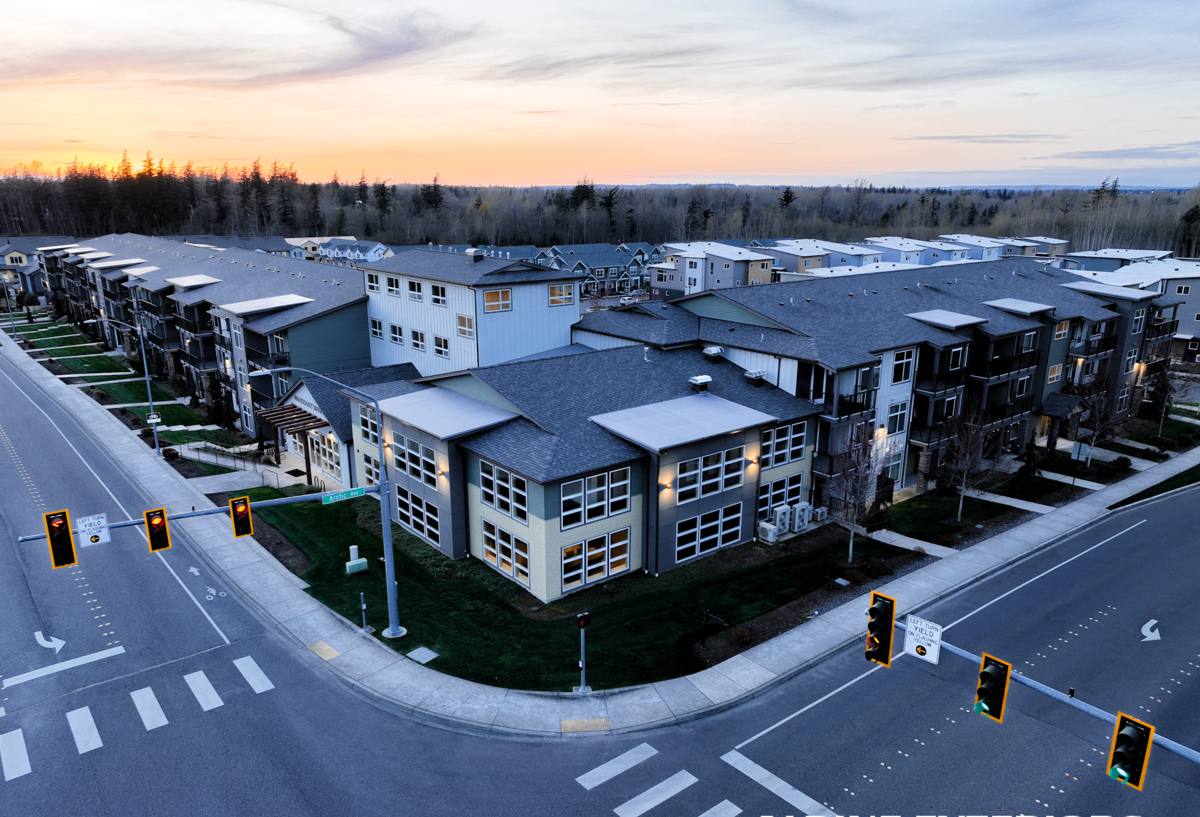
Why Fiber Cement Holds Up Where Other Products Struggle
We install James Hardie fiber cement siding exclusively, and we don't install vinyl, LP SmartSide, primed wood, or comparable fiber cement alternatives like Cemplank or Allura. That's not a marketing position — it's a standard we hold because of what we see happen to homes in this specific climate over a 10, 15, and 20-year horizon.
Vinyl siding softens and warps under sustained UV exposure and can crack in cold snaps; more relevant to Cordata, it also gives moss and mildew an easy foothold at its overlapping panel seams, where trapped moisture rarely dries out fully between rain events. Engineered wood products like LP SmartSide use a wood-strand substrate that, while treated, is still fundamentally organic — any breach in the factory coating or field-cut edge sealing creates a path for moisture intrusion, and once wood-based siding starts to swell or delaminate, there's no partial fix. Primed wood and cedar require the most diligent, recurring maintenance of any option, which is a hard ask in a climate where paint film rarely gets a long enough dry window to cure and hold.
What Fiber Cement Gets Right
James Hardie siding is cement, sand, and cellulose fiber — it doesn't rot, it isn't a food source for moss or mildew, and it's non-combustible. It's also engineered specifically for wet climates: the HZ5 product line is formulated for regions like ours, with a moisture-resistant composition that performs differently than the HZ10 line built for hot, dry climates. That regional engineering matters more in Whatcom County than almost anywhere in the Lower 48.
ColorPlus Factory Finish
Most of what we install uses Hardie's ColorPlus finish — a baked-on, factory-applied coating that's more UV- and weather-resistant than field-applied paint, backed by its own finish warranty. In a climate that limits the number of dry days available for a quality field paint job, starting with a factory finish removes that variable entirely.
What a Correct Fiber Cement Installation Actually Involves
Fiber cement siding is only as good as the installation behind it. In a high-moisture climate like Cordata's, the details that get glossed over on a rushed job are exactly the details that cause callbacks two or three winters later.
Moisture Barrier and Flashing
A weather-resistive barrier goes on the sheathing before any siding, with all seams properly lapped and taped to shed water downward and outward. Flashing at windows, doors, and every horizontal trim transition has to integrate with that barrier correctly — not just sit on top of it — so that wind-driven rain has nowhere to collect and migrate behind the cladding.
Fastening and Clearances
Hardie's install specs call for corrosion-resistant fasteners, set at the correct depth and location on the board — over-driven or under-driven nails are one of the most common causes of premature failure. Clearance matters just as much: siding needs a minimum gap above roof lines, decks, and grade, and at least a small gap where it meets other building elements, so water can drain and air can circulate instead of wicking up into the board's cut edges.
Joint Treatment and Caulking
Butt joints, corners, and penetrations need to be sealed with a product rated for the movement and moisture exposure they'll see — not just whatever caulk happens to be on the truck. Cut edges, which are more absorbent than the factory-finished face, need to be primed and sealed before the board goes up, not after.
None of this is exotic. It's the manufacturer's published installation standard. But skipping steps is exactly how a good product ends up with a bad reputation, and it's the single biggest reason we control installation quality ourselves rather than treating it as a commodity labor task.
Our Installation Process for Cordata Homes
- On-site assessment. We look at your home's current siding, trim, and any signs of past moisture intrusion — soft spots, staining, or moss buildup at shaded elevations — before recommending a scope of work.
- Tear-off and substrate check. Old siding comes off and we inspect the sheathing underneath. Any water-damaged sheathing gets identified and addressed before new siding goes on; covering a compromised substrate just hides a problem.
- Weather barrier and flashing installation. House wrap, flashing at all penetrations and transitions, and integration at windows and doors, done to manufacturer spec.
- Hardie board installation. Panels, planks, or shingle-style siding installed with correct fastening, clearances, and joint sealing throughout.
- Trim and detail work. Corners, fascia, and trim boards finished to shed water cleanly at every transition point.
- Final walkthrough and cleanup. We review the completed work with you and clear the site of debris and old material.
Comparing Siding Options for a Cordata Home
| Factor | James Hardie Fiber Cement | Vinyl | Engineered Wood / Cedar |
|---|---|---|---|
| Moisture & moss resistance | Strong — non-organic, HZ5 formulated for wet climates | Moderate — seams trap moisture | Weak to moderate — organic substrate, needs sealing |
| Salt-air durability | Strong | Moderate — can chalk and become brittle | Weak — accelerates coating breakdown |
| Maintenance | Low — factory ColorPlus finish, no repainting cycle | Low, but limited repair options if damaged | High — recurring paint/stain and caulk maintenance |
| Fire resistance | Non-combustible | Combustible, can melt/deform | Combustible |
| Typical lifespan when correctly installed | Multiple decades with warranty backing | Shorter, especially in UV/wet cycling | Shortest without diligent upkeep |
What Drives Cost on a Cordata Siding Project
Every home is different, but a few factors consistently move the price of a siding installation up or down in this area:
| Cost Factor | Why It Matters |
|---|---|
| Home size and elevation complexity | More square footage, dormers, and roof lines mean more cutting, flashing, and labor time |
| Existing wall condition | Water-damaged sheathing discovered during tear-off adds repair scope before new siding can go on |
| Siding profile chosen | Lap siding, shingle-style, and panel systems differ in material and labor cost |
| Trim and detail scope | Corner boards, fascia wraps, and window/door trim add finish work beyond the field siding |
| Access and site conditions | Tight lots, mature landscaping, or multi-story elevations affect staging and scaffolding needs |
We give you a written, itemized estimate before any work starts — no vague allowances, so you know exactly what you're paying for and why.
Choosing a Siding Contractor for Your Cordata Home
Not every contractor who sells fiber cement installs it to spec. Since the product's long-term performance depends almost entirely on installation quality, the contractor matters as much as the material. Before hiring anyone, it's worth checking:
- Are they a licensed and insured Washington contractor, and can they show proof?
- Do they install to James Hardie's published fastening, clearance, and flashing specifications — not just "similar to code"?
- Will they inspect and address sheathing damage found during tear-off, rather than covering it up?
- Do they provide a written scope and itemized estimate before work begins?
- Are they familiar with Whatcom County permitting and local building department requirements?
- Do they stand behind their installation work with a labor warranty, separate from the manufacturer's material warranty?
Why Local Experience in Cordata Matters
A crew that already works throughout Bellingham and Whatcom County has seen how homes in this specific microclimate actually fail — which north-facing walls hold moss longest, which trim details let water in over time, and how local permitting and inspection processes run. That's different from general siding experience picked up in a drier or milder region. It also means we're not guessing at how James Hardie's HZ5 line performs here; we've installed it across the same weather patterns your home deals with year-round, and we stand behind the work locally, not from a call center somewhere else.
After Installation: What Cordata Homeowners Should Expect
Correctly installed Hardie siding with a ColorPlus finish is genuinely low-maintenance, but "low" isn't "none." An occasional rinse to clear pollen, debris, or early moss growth from shaded areas keeps the finish looking its best, and it's worth a visual check after major storms to confirm caulking and trim joints are holding up. Because the finish is factory-applied, you're not on a repainting cycle the way you would be with field-finished wood — that alone removes the biggest recurring maintenance burden homeowners in this climate deal with.
If you're planning a siding project in Cordata, we're happy to take a look at your home and walk you through what it actually needs — no pressure, no hard sell, just a straight assessment and a written estimate you can think over.