 Bellingham
 Composite Decking for Sunnyland Homes
Sunnyland sits close enough to Bellingham Bay that its homes deal with a specific combination of weather: damp salt-tinged air off the water, long stretches of driving rain through fall and winter, and shaded, moisture-holding yards that stay green with moss most of the year. That combination is hard on outdoor wood surfaces. A deck that looks fine in July can be growing a slick green film by November, and boards that were flat when installed can cup, crack, or splinter within a few seasons if the wrong material or the wrong build went into them.
Composite decking was designed for exactly this kind of climate. It doesn't absorb water the way wood does, it doesn't need annual staining, and it resists the moss and mildew growth that's constant background noise for any exterior surface in Whatcom County. That doesn't mean composite is maintenance-free or that every composite deck performs the same — it means that when it's specified and installed correctly for our conditions, it holds up dramatically better than untreated or even pressure-treated wood over a 10-20 year span.
This page is specifically about composite decking work in Sunnyland — what the local conditions demand, what a correctly built deck actually involves, and what our process looks like from first visit to final walkthrough.
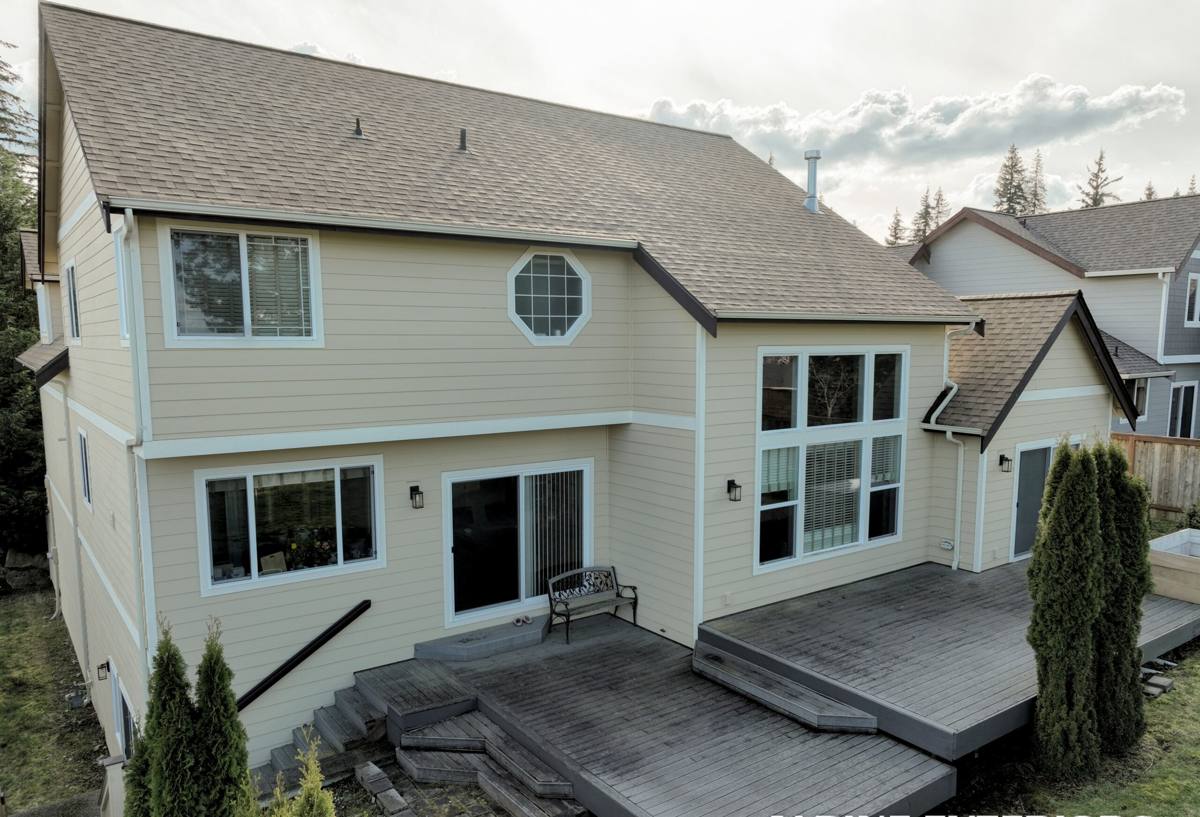
What Bellingham's Climate Actually Does to a Deck
It helps to be specific about the failure modes we see, because they drive every decision in the build:
Moisture Cycling
Bellingham gets extended wet seasons where a deck surface can stay damp for days at a time, followed by drier stretches. Wood expands and contracts with that cycle, which loosens fasteners, opens up checking cracks, and eventually warps boards. Composite material moves far less with moisture, which is the single biggest reason it outperforms wood here.
Moss and Algae Growth
Shaded yards, filtered sun, and near-constant ambient humidity make Whatcom County close to ideal moss habitat. Moss on a wood deck isn't just cosmetic — it holds moisture against the board surface and accelerates rot underneath. Composite doesn't feed moss the way wood fiber does, but it can still develop a surface film that needs periodic cleaning, especially on north-facing or heavily shaded sections of a deck.
Salt Air and Corrosion
Homes closer to the water pick up salt-laden air that corrodes standard fasteners and hardware faster than it would further inland. This is a substructure issue as much as a decking-material issue — it affects what screws, brackets, and joist hangers we spec, not just the boards on top.
Driving Rain and Water Intrusion
Wind-driven rain off the bay pushes water sideways, not just down. That matters at the point where a deck meets the house — ledger board flashing and proper drainage detailing there matter as much as the decking material itself.
Composite vs. Wood vs. PVC: An Honest Comparison
There's no single "best" decking material for every project — it depends on budget, how the deck will be used, and how much upkeep a homeowner wants to do. Here's how the three most common options actually compare for a Whatcom County exterior:
| Material | Moisture Behavior | Maintenance | Typical Lifespan | Upfront Cost |
|---|---|---|---|---|
| Pressure-treated wood | Absorbs water, prone to cupping/splitting in wet cycles | Annual cleaning, periodic staining/sealing | 10-15 years with upkeep | Lowest |
| Composite | Minimal absorption, dimensionally stable | Occasional wash-down, no staining | 25-30 years, often warrantied | Mid-range |
| PVC / cellular decking | Fully moisture-resistant, does not absorb water at all | Occasional wash-down | 25+ years | Highest |
We install composite most often in this neighborhood because it hits the balance point: it handles our moisture and moss conditions well, it's more affordable than full PVC systems, and the better composite lines now come with fade and stain warranties that reflect real confidence from the manufacturer. We're happy to talk through PVC or other options too — the right call depends on the project.
What a Correct Composite Deck Installation Involves
Composite boards are only as good as what's underneath and how they're fastened. A lot of the decks we get called to repair or rebuild weren't failures of the decking material — they were failures of the substructure or the install method. For our climate, a correct build includes:
- Joist spacing matched to the specific composite product's engineering specs — composite typically needs tighter joist spacing than wood, and skipping this causes bounce and long-term sagging
- Corrosion-resistant fasteners and hardware, especially important given salt air exposure closer to the water
- Proper ledger board flashing where the deck attaches to the house, to keep driving rain from working behind the siding
- Hidden fastener systems where the product allows it, for a cleaner look and fewer surface penetration points where water can sit
- Airflow and drainage underneath the deck so moisture doesn't pool against the substructure — critical in a yard that stays damp for long stretches
- Board gapping set correctly for composite's expansion behavior, not copied from a wood-decking spacing habit
None of this is visible once the deck is finished, which is exactly why it matters who does the work. A deck can look identical on day one whether the substructure was done right or cut short — the difference shows up in year three or four.
Our Process
1. On-Site Assessment
We look at the existing structure (if there is one), the yard's drainage and sun exposure, and how the deck connects to the house. This is where we flag anything specific to the site — shaded areas prone to moss, low spots that hold water, or existing rot in a ledger board.
2. Product Selection
We walk through composite options at different price points and explain the real differences — color and grain retention, warranty terms, and how each line handles moisture over time. No pressure toward the most expensive option; we tell you honestly what fits the project and budget.
3. Framing and Substructure
Any framing repair or replacement happens before a single composite board goes down. This is the step that determines how the deck performs in year five, not just how it looks on day one.
4. Installation
Boards are installed to the manufacturer's specified spacing and fastening method, with attention to drainage and flashing at every point the deck contacts the house or the ground.
5. Walkthrough
We go over care basics with you before we leave — what to expect in year one, how to clean it, and what (if anything) is under warranty and how that warranty works.
Maintaining a Composite Deck in a Mossy, Wet Climate
Composite is low-maintenance, not no-maintenance. In Sunnyland's conditions, a little seasonal attention goes a long way:
- Sweep debris off regularly — wet leaves and needles left sitting are the main cause of surface staining and mildew film
- Wash the deck surface with soap and water (or a manufacturer-approved cleaner) once or twice a year, more often on shaded sections
- Keep gutters and downspouts near the deck clear so runoff isn't dumping directly onto or under the deck surface
- Check underneath periodically for standing water or blocked airflow, especially after long wet spells
- Avoid pressure-washing at close range or high pressure — it can damage the surface texture on some composite products
- Inspect railings and fastener points annually, particularly on homes closer to the water where corrosion moves faster
What Affects Cost
Every deck is different, but these are the main variables that move the price:
| Factor | Why It Matters |
|---|---|
| Deck size and shape | More square footage and more cuts/angles increase material and labor |
| Existing substructure condition | Rotted framing or an undersized structure needs rebuilding before decking goes on |
| Composite product tier | Entry-level, mid-range, and premium composite lines vary significantly in price and warranty coverage |
| Railing system | Composite, cable, or metal railing all add different amounts of labor and material cost |
| Height and access | Elevated decks or difficult site access add framing and safety requirements |
| Permitting | Most deck rebuilds and new builds in Bellingham require a permit, which adds time and a fee |
We give you real numbers after seeing the site, not a phone-quote guess — deck pricing swings too much based on substructure condition to estimate accurately sight unseen.
Why Hire a Crew That Already Works in Sunnyland
A contractor who works this neighborhood regularly already knows what Bellingham's permitting process expects for deck work, understands how Whatcom County's rain and moss patterns affect material choices, and has seen how different composite lines actually hold up locally — not just what the manufacturer's brochure claims. That local track record matters more than it sounds like it should: it means fewer surprises during permitting, a build that accounts for this specific climate from the start, and a crew that stands behind the work because they're not driving out from somewhere else if something needs a look later.
Get a Free Estimate
If you're weighing a new composite deck or replacing a wood deck that's showing its age, we're happy to come take a look and give you a straight, no-pressure estimate. Use the form below to get started.