 Bellingham
 Asphalt Shingle Roofing Built for Lynden's Weather
Lynden sits inland from the coast, but it doesn't escape Whatcom County's core problem: the roof spends most of the year wet. Long stretches of steady, driving rain move in off the Pacific and settle over the Nooksack Valley for days at a time, and the shaded, tree-lined lots common around Lynden keep roof surfaces damp well after a storm has passed. That combination is exactly what asphalt shingle roofs need to be designed and installed to handle — not just materials that look right on the truck, but a system of underlayment, flashing, and ventilation that actually sheds water and dries out between rain events.
We install and repair asphalt shingle roofs across Whatcom County, from properties closer to the coast that deal with salt-laden air and wind-driven rain, to inland communities like Lynden where the bigger enemy is moisture that lingers on shaded roof planes and turns into moss. A roof built for a dry climate, or installed by a crew that treats every job the same regardless of region, will underperform here. This page covers what an asphalt shingle roof actually needs in Lynden, what correct installation and repair work looks like, and how our process runs from first look to final walk-through.
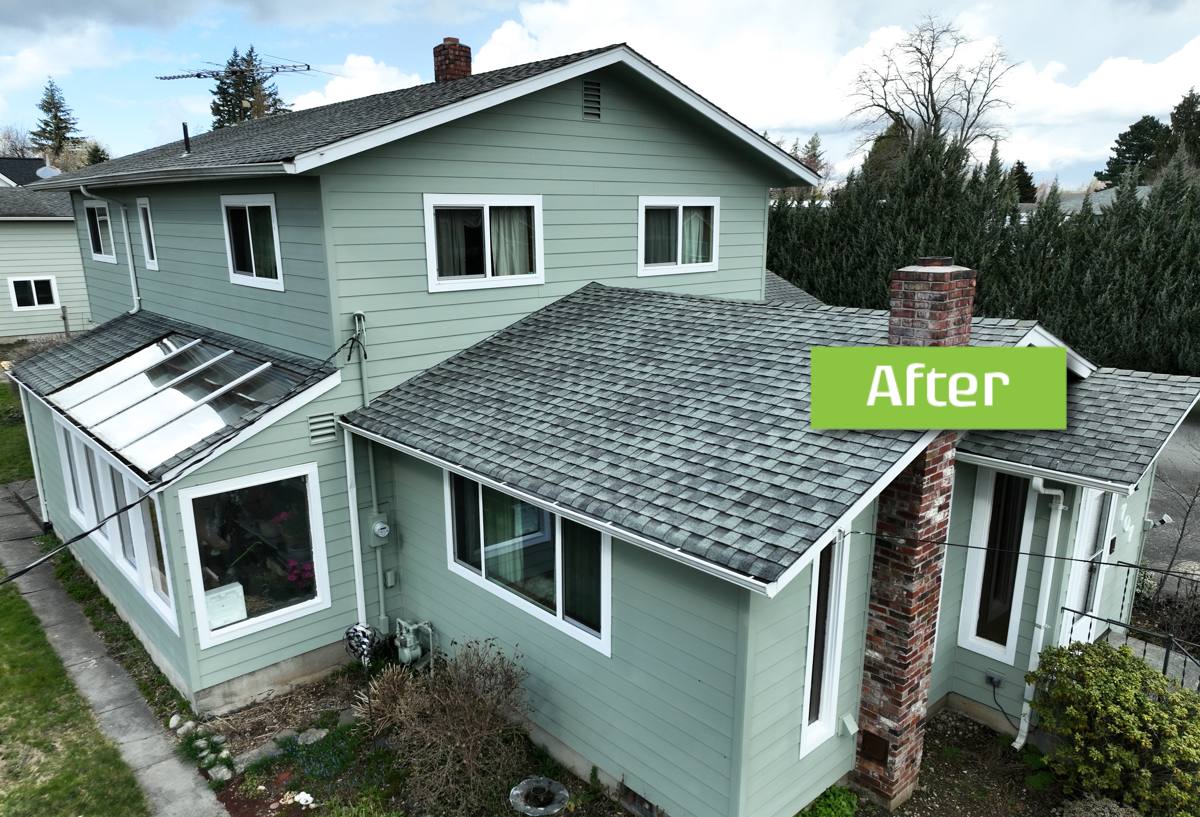
What Whatcom County's Climate Does to a Shingle Roof
Three things drive most of the shingle roofing work we do in this part of the county, and they don't act alone — they compound each other over the life of a roof.
A Long, Wet Moss Season
Whatcom County's moss season isn't a few weeks — it's most of the fall, winter, and spring. Shaded roof slopes, north-facing planes, and areas under overhanging trees stay damp long enough for moss and algae to take hold. Once moss establishes itself, it holds moisture directly against the shingle mat, works its way under shingle edges, and lifts tabs enough for wind-driven rain to get underneath. A roof that looks fine from the ground can already have moss doing quiet damage at the seams.
Driving Rain and Wind
Storms here don't always come straight down. Wind pushes rain sideways and up under shingle edges, especially at ridges, valleys, and anywhere the roofline changes plane. That's why flashing detail and shingle sealing matter more here than in drier climates — a roof that would be fine with basic installation somewhere else can leak in Whatcom County if the flashing and underlayment weren't done to handle wind-driven water.
Salt Air Near the Coast
Properties nearer to Bellingham Bay and the coastline deal with salt-laden air that accelerates corrosion on exposed metal — nails, flashing, and vent components in particular. Lynden is far enough inland that this is less of a factor day to day, but we build every roof to the same corrosion-resistant fastener and flashing standard across the county, because weather patterns and wind direction don't respect a hard line on a map.
What a Correct Asphalt Shingle Installation Actually Involves
Asphalt shingle roofing looks like a simple product — overlapping shingles nailed to a deck — but most leaks we get called out to fix didn't come from bad shingles. They came from shortcuts in the layers underneath, or corners cut on flashing and ventilation. A correct job includes:
- Full tear-off and deck inspection — removing old roofing down to the decking, checking for soft spots, rot, or delamination, and replacing any bad sections before anything new goes down.
- Ice and water shield at vulnerable areas — self-adhering waterproof membrane at eaves, valleys, and around penetrations, where wind-driven rain and ice dams are most likely to force water backward under shingles.
- Synthetic underlayment across the full deck — a continuous water-resistant layer under the shingles that backs up the primary roofing surface if wind ever lifts a shingle edge.
- Properly lapped and sealed flashing — at chimneys, skylights, sidewalls, valleys, and any roof-to-wall transition, since these are the highest-risk leak points on any roof.
- Correct nailing pattern — the right number of nails, placed in the manufacturer's specified nailing zone, driven flush (not overdriven or underdriven) — this is one of the most common places corners get cut on a rushed job.
- Balanced attic ventilation — intake at the eaves and exhaust at the ridge, sized to move air through the attic and keep the underside of the deck dry.
- Manufacturer-matched components — using the shingle brand's own starter strips, ridge caps, and hip/ridge shingles so the warranty stays intact.
Skip any one of these and the roof may look fine for a year or two before a problem shows up — usually as a slow leak that's already caused hidden damage by the time it's visible inside.
Repair, Re-Roof, or Replace: How We Help You Decide
Not every roof problem in Lynden needs a full replacement. We look at the age of the roof, the extent of the damage, and whether the underlying deck and flashing are sound before recommending anything.
| Situation | Usually Fixable With Repair | Usually Needs Replacement |
|---|---|---|
| Isolated missing or damaged shingles | Yes, if shingles are still available to match | No, unless widespread across the roof |
| Moss buildup with intact shingles underneath | Yes — clean and treat, then monitor | No, unless moss has caused shingle lift or granule loss |
| Flashing leak at chimney or valley | Yes — flashing repair or replacement | No, if the roof field is otherwise sound |
| Widespread granule loss / curling shingles | Rarely — sign of age, not a spot fix | Yes |
| Roof age 20+ years with recurring leaks | Rarely a lasting fix | Yes |
| Soft or spongy deck sections | No — deck must be replaced regardless | Yes, at least in that section |
If a roof is within its expected service life and the damage is contained, we'll say so and quote a repair. We don't push replacement on a roof that doesn't need it — but we'll also be straight with you if a repair is just delaying a bigger bill.
Our Process, Start to Finish
1. On-Site Inspection
We get on the roof, not just look at it from the driveway. That means checking the deck condition where accessible, the state of existing flashing, attic ventilation, and how the roof has been draining and shedding moss.
2. Written Scope and Estimate
You get a clear, itemized estimate — what's being torn off, what underlayment and flashing package is included, the shingle line and color, and the ventilation plan. No vague "roof replacement" line item with everything buried in it.
3. Property Protection
Before tear-off starts, we protect landscaping, siding, and anything below the work area, and set up for safe, controlled debris removal — tear-off produces a lot of material and we manage it so it doesn't end up in your yard or gutters.
4. Tear-Off and Deck Repair
Full removal of the old roofing, deck inspection, and replacement of any damaged sheathing before a single new component goes down.
5. Installation
Ice and water shield, underlayment, flashing, starter strips, shingles, and ridge components installed in the correct sequence and to manufacturer nailing specs.
6. Cleanup and Walk-Through
Magnetic sweep for nails, full debris haul-off, and a walk-through so you know what was done and what to watch for going forward.
Shingle and Product Choices
Most Lynden homes are well served by a standard three-tab or architectural (laminated) asphalt shingle from an established manufacturer. Architectural shingles are heavier, carry a longer warranty, and hold up better to wind uplift — worth the modest upcharge on most roofs given how much wind-driven rain this region sees. We steer away from lower-tier shingle lines with thin mats and minimal wind ratings; they're less forgiving of the freeze-thaw and constant moisture cycling that Whatcom County roofs go through, and the labor to install a cheap shingle costs the same as installing a good one.
We also pay attention to algae-resistant (AR) shingle lines, which use copper-infused granules to slow the black streaking and moss growth that's a near-constant issue on shaded roofs in this area. It's not a permanent fix for moss — nothing is — but it meaningfully extends the time between cleanings.
Ventilation: The Part Homeowners Rarely See
A shingle roof's biggest enemy from underneath is trapped heat and moisture in the attic. Without balanced intake and exhaust ventilation, moisture from daily living (cooking, showers, laundry) rises into the attic, condenses on the cold underside of the deck, and slowly rots the sheathing from the inside — completely separate from anything happening on the outside of the roof. In Whatcom County's damp climate, this happens faster than in drier regions. We check and correct ventilation as part of every re-roof, because a new shingle roof over a poorly ventilated attic will fail from the inside before its time.
Maintenance Checklist for Lynden Homeowners
- Clean gutters at least twice a year — clogged gutters back water up under the shingle edge at the eave
- Have moss treated or removed before it thickens, especially on shaded, north-facing slopes
- Trim back overhanging branches that keep roof sections shaded and damp
- Check attic insulation and ventilation if you notice ice buildup at the eaves in cold snaps
- After major windstorms, do a visual check from the ground for lifted or missing shingles
- Address small leaks immediately — a slow drip in the attic can go unnoticed for months and cause real deck damage
Why Hire a Roofing Crew That Already Works Lynden
A crew that works Whatcom County regularly knows which roof details actually matter here — where moss builds up fastest, which flashing details fail first under driving rain, and how to size ventilation for our wet season rather than a generic national spec. That local pattern recognition is the difference between a roof that's technically installed to code and one that's built to hold up to how this area actually behaves. We stand behind our workmanship and use manufacturer-approved installation methods so your shingle warranty stays valid, not voided by a shortcut nobody told you about.
If you're dealing with a leak, aging shingles, heavy moss, or you're just planning ahead for a roof that's getting close to the end of its life, we're happy to take a look. Use the form below to request a free, no-pressure estimate — we'll walk the roof, tell you honestly what condition it's in, and lay out your options in plain terms.