 Bellingham
 Composite Decking for Silver Beach Homes
Silver Beach is one of those Bellingham neighborhoods where the trees do a lot of the work of blocking wind and sun — which is great for shade in August and miserable for anything wooden sitting outside year-round. A deck in this part of Whatcom County spends most of the year damp, shaded, and slow to dry out between rains. That combination is exactly what wears out an under-built or poorly chosen deck faster than homeowners expect, and it's exactly what a properly installed composite deck is designed to handle.
This page is specifically about composite decking in Silver Beach — not a general product overview. We're covering what the local climate actually does to decks here, what a correct composite installation looks like, and how our process works from the first estimate to the last board.
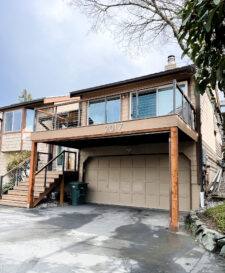
What Whatcom County Weather Does to a Deck
Bellingham's marine climate is mild, but it's relentless. Long stretches of drizzle, high ambient humidity off Bellingham Bay, and short, low-angle winter sun mean surfaces near tree cover or on the shaded side of a house can stay damp for days after a storm passes. A few specific effects show up again and again on decks in and around Silver Beach:
- Moss and algae growth on any surface that doesn't dry out fully between rain events, especially north- and east-facing decks under tree canopy
- Slow moisture wicking into end grain, fastener holes, and joist tops on wood decks, which is where rot typically starts
- Freeze-thaw cycling in winter cold snaps that opens up small cracks and lets more water in the following season
- UV and heat stress during the drier summer stretch, which causes fading and checking on any decking that isn't UV-stabilized
None of this is dramatic on its own. It's cumulative. A deck built without accounting for it looks fine for two or three years, then starts showing soft spots, black staining, and surface checking right around the time a homeowner assumed they'd bought themselves a decade of low maintenance.
Why Composite Makes Sense for This Neighborhood
We install wood decks too, and wood is still the right call for some homeowners and some budgets. But for Silver Beach's shaded, damp conditions, composite decking solves the specific problems that show up here:
Composite boards don't absorb water the way wood fibers do, so they aren't feeding the slow rot cycle that starts at fastener holes and end cuts. They don't need annual staining or sealing to keep moisture out, which matters on a deck that's already fighting a long wet season. And a quality capped composite board resists the surface mold and algae staining that shaded wood decks in this area tend to develop, though it still needs periodic cleaning — composite is low-maintenance, not no-maintenance.
The trade-off is upfront cost and, with some products, a plastic-adjacent look if you go cheap. That's a real trade-off, and we'll tell you honestly if a wood deck fits your situation and budget better. Our job is to size up your specific site — sun exposure, drainage, how close you are to tree cover — and tell you what actually makes sense, not to sell composite as a universal answer.
Where Composite Struggles
Composite isn't magic. Deep scratches and gouges are harder to repair invisibly than on wood. Very cheap, uncapped composite from years past had real problems with moisture absorption and mold in exactly the shaded, damp conditions common around Silver Beach — that's a documented weakness of first-generation composite, which is why we don't recommend or install uncapped boards in shaded sites here.
Capped vs. Uncapped Composite: What We Install and Why
Not all composite decking is built the same way, and the difference matters more in a climate like ours than it does in a dry climate.
| Feature | Capped Composite | Uncapped / First-Generation Composite |
|---|---|---|
| Moisture resistance | Polymer shell resists water intrusion at the surface | Wood fiber core exposed, absorbs moisture over time |
| Mold/mildew resistance | Much better performance in shaded, damp sites | Prone to surface mold in exactly Silver Beach's conditions |
| Fade and stain resistance | UV-stable cap resists fading and staining | Fades and stains faster, especially under tree drip |
| Upfront cost | Higher | Lower |
| Our recommendation for this area | Standard choice | Not recommended for shaded or low-drainage sites |
Within capped composite, board profile, color, and warranty terms vary by manufacturer. We'll walk you through the options that fit your budget rather than pushing one brand — the right board depends on your deck's sun exposure, your color preference, and what you're trying to spend.
What a Correct Composite Installation Actually Involves
Composite decking is forgiving in some ways and unforgiving in others. The board itself resists moisture, but the structure underneath it still has to be built right, or you've just put a nice surface on a problem waiting to happen.
Framing and Structure
Joist spacing for composite is typically tighter than for wood — most manufacturers require 16" on-center or closer, sometimes 12" for diagonal patterns or certain board profiles. Skipping this is one of the most common corner-cutting mistakes we see on decks that need early repair; it shows up as bounce and eventual sagging between joists.
Drainage and Airflow Underneath
Given how long things stay damp here, the space under the deck needs to actually drain and breathe. That means correct ledger flashing where the deck meets the house, joist tape or flashing on top of the framing to keep water out of the wood structure, and grading or gaps that let water move away instead of pooling under the deck.
Fastening
Hidden fastener systems are standard on quality composite installs — they keep the deck surface free of exposed screw heads, which both looks cleaner and removes another point where water could sit. Fastener spacing and gapping between boards has to account for composite's thermal expansion, which is more pronounced than wood's.
Railings, Stairs, and Code
Railing height, baluster spacing, and stair geometry are governed by Whatcom County building code, and permits are typically required for decks above a certain height or attached to the house. We handle the permit process as part of the job rather than leaving it on the homeowner.
Our Process, Start to Finish
- Free on-site estimate: we look at your existing deck or build site, check drainage, sun exposure, and access, and talk through composite options and budget
- Written proposal: clear scope, board selection, structural notes, and a firm price before any work starts
- Permit handling: we pull the required permits from the City of Bellingham or Whatcom County as applicable
- Demo and structural work: removal of the old deck if applicable, framing built or reinforced to spec
- Composite installation: hidden fasteners, correct gapping, and proper flashing detail throughout
- Final walkthrough: we go over the finished deck with you, including what maintenance it actually needs
Maintenance: What You'll Actually Need to Do
One of the honest selling points of composite is how little upkeep it needs compared to wood — but "little" isn't "none," especially under Silver Beach's tree cover.
- Sweep off leaves, needles, and debris regularly, especially in fall — trapped organic matter holds moisture against the board surface
- Wash the deck with soap and water (or a manufacturer-approved composite cleaner) once or twice a year to prevent moss and algae buildup in shaded areas
- Keep gutters and downspouts near the deck clear so you're not dumping extra water onto or under it
- Trim back overhanging branches where practical to improve sun and airflow across the deck surface
- Check railings and stair connections annually for looseness, same as you would on any deck
What Affects the Cost
Composite decking costs more upfront than pressure-treated wood and less than many premium hardwoods, but the total project price depends on more than just the board material.
| Factor | Why It Matters |
|---|---|
| Deck size and shape | More linear footage, more cuts, and complex angles all add labor |
| Board tier (capped vs. premium capped) | Higher-end boards cost more per square foot but resist fading and staining longer |
| Height and structure | A second-story or elevated deck needs more substantial framing and railing work |
| Site access and existing deck removal | Tight lots or tree-heavy yards around Silver Beach can slow demo and material staging |
| Railing style and stairs | Composite or metal railing systems add cost over basic wood rail |
| Permit and inspection requirements | Attached, elevated decks generally require permitting, which adds time but isn't optional |
We give firm, itemized pricing after the on-site visit — not a vague range over the phone — because so much depends on your specific deck and site.
Why It Matters to Hire a Crew That Already Works in Silver Beach
A lot of deck problems we get called to fix started with a builder who didn't account for local conditions — not because they were careless everywhere, but because they were used to a different climate or a different kind of site. Framing that's fine in a dry, sunny yard can be undersized for a shaded, damp lot near Lake Whatcom or closer to the bay. Drainage details that work on an open, sloped site don't automatically work under heavy tree cover.
We work throughout Bellingham and Whatcom County, including Silver Beach and the surrounding neighborhoods, and we build every composite deck to handle the moisture, shade, and moss pressure that's normal here — not to a generic spec. That means correct joist spacing for our climate, real drainage planning, and board selection that accounts for how much sun (or how little) your specific yard gets.
If you're weighing composite decking for a home in Silver Beach, we're glad to come take a look and give you a straight, no-pressure estimate — including telling you if composite isn't actually the best fit for your site. Use the form below to get started.