 Bellingham
 Why Decks in Sehome Wear Out Faster Than Homeowners Expect
Sehome is one of Bellingham's older, established neighborhoods, and that means a lot of its decks are older too — built in an era when builders didn't always think about what Whatcom County weather does to wood and fasteners over twenty or thirty years. Add in the neighborhood's mix of sloped lots, mature tree cover, and homes sited close enough to Bellingham Bay to catch salt-laden air, and you get a combination that's hard on outdoor structures.
The damage rarely shows up all at once. It's the slow kind: moisture wicking into end grain, fasteners rusting from the inside out, moss building up in the shaded, north-facing corners that never fully dry between rain events. By the time a deck looks obviously bad — soft boards, wobbly railings, gaps at the ledger board — the structure underneath has often been compromised for years.
A deck replacement done right for this area isn't just swapping old boards for new ones. It's addressing the specific ways driving rain, salt air, and a long moss season attack a structure, so the new deck doesn't fail the same way the old one did.
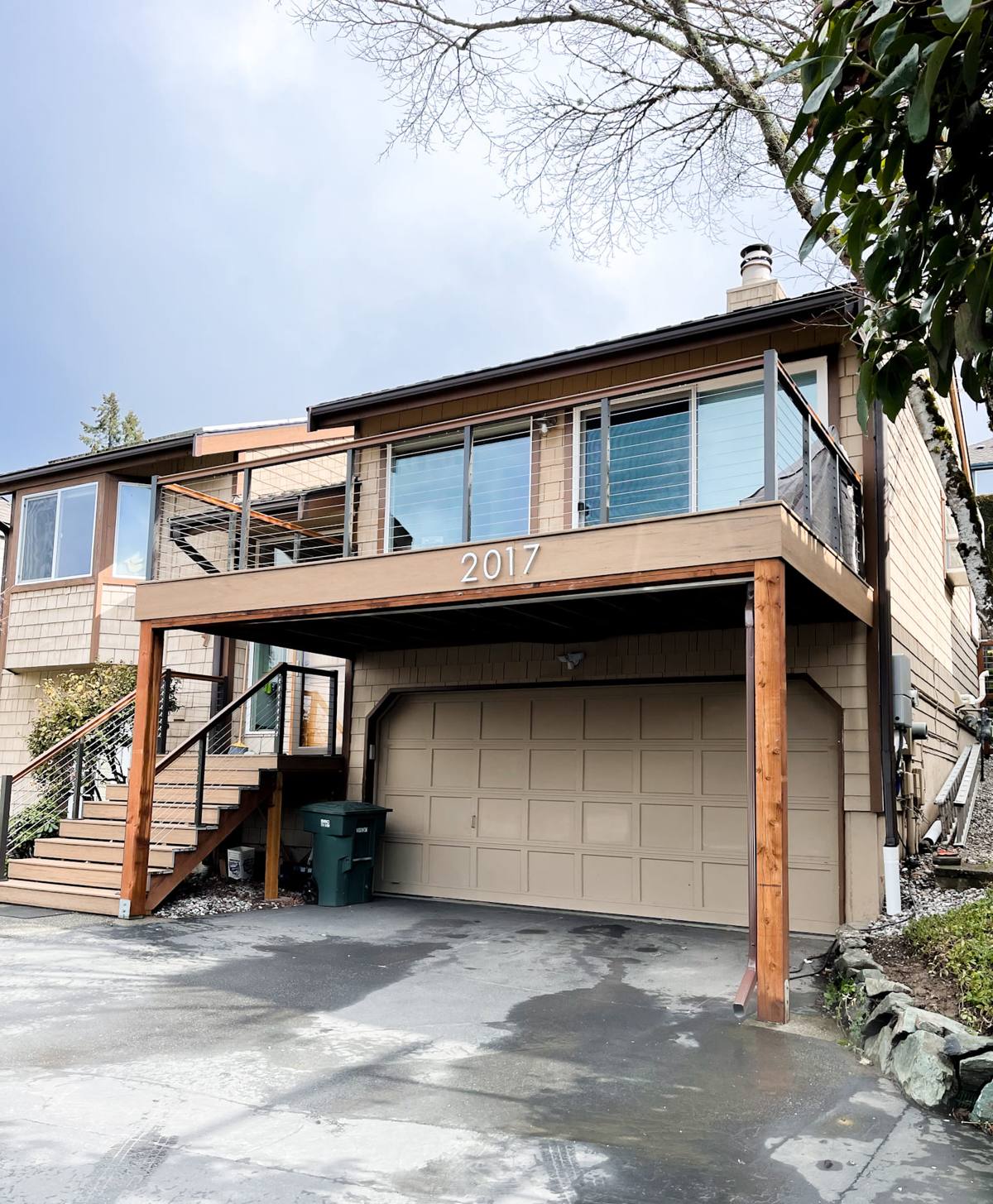
Repair or Replace? Reading the Signs Correctly
Not every tired-looking deck needs a full replacement, but a lot of decks that "just need a few boards" actually need much more. Here's how we tell the difference on a typical Sehome property.
Usually repairable
- A handful of surface boards cupping or splintering while the framing underneath is still solid
- Loose railing balusters or a wobbly stair stringer with no rot at the connection points
- Surface-level moss and algae staining with no soft spots when probed
Usually a replacement situation
- Soft, spongy decking in multiple areas, especially near the house or in shaded corners
- Visible rot, staining, or gaps at the ledger board where the deck attaches to the house
- Rusted, streaking fasteners or joist hangers that have lost their grip
- A deck that was never properly flashed at the house connection — the single most common failure point we find in this climate
- Framing built from undersized or non-rated lumber for the span and load it's carrying
When in doubt, we'll tell you honestly which category your deck falls into. There's no advantage to us in talking a homeowner into a full replacement they don't need — but there's real risk in patching over a structural problem that's only going to resurface.
What Actually Damages Decks in This Climate
Three things do most of the work: driving rain that gets pushed sideways into joints and end grain by wind off the bay, a moss season that can stretch from fall through spring on shaded or north-facing sections, and salt-tinged air that accelerates corrosion on fasteners and hardware faster than it would inland. None of these are dramatic on their own, but stacked year after year, they find every weak point in a deck's original construction — especially places where end grain was left unsealed, flashing was skipped, or standard fasteners were used instead of corrosion-resistant ones.
This is why a deck built without those specifics in mind can start showing real problems in half the time a properly built one would, even using the same lumber.
Choosing Materials That Actually Hold Up
There's no single "right" decking material for every home — it depends on budget, how much upkeep you want to do, and how the deck is situated. Here's how the common options compare for a Sehome property specifically.
| Material | Moisture / Moss Resistance | Maintenance | Typical Lifespan | Relative Cost |
|---|---|---|---|---|
| Pressure-treated lumber | Good if sealed and re-sealed regularly; moss still grips the grain | Annual cleaning and re-sealing recommended | 10–15 years | Lowest |
| Cedar | Naturally moisture- and insect-resistant, but greys and can stain without upkeep | Periodic cleaning and oiling for appearance | 15–20 years | Moderate |
| Composite decking | Very good — doesn't absorb water or feed moss the way wood does | Occasional washing, no sealing or staining | 25–30+ years | Higher upfront |
| PVC decking | Excellent — fully moisture-sealed material | Lowest maintenance of any option | 25–30+ years | Highest upfront |
We install all of these categories and won't push you toward the highest-margin option. What we will do is walk you through the honest trade-offs: wood costs less to install but costs more in time and upkeep over the years, while composite and PVC cost more up front but largely take moss and moisture damage out of the equation. For a shaded, moss-prone lot, that difference matters more than it would on a wide-open, sun-exposed deck.
Hardware Matters as Much as the Decking
A deck is only as good as what's holding it together. In coastal Whatcom County conditions, we use stainless steel or high-grade coated fasteners and joist hangers rather than standard galvanized hardware, because standard hardware is exactly where we most often find early corrosion on decks we're asked to replace. Hidden fastener systems are also worth considering on composite and PVC decks — they eliminate the exposed screw heads that are the first place moisture and grime take hold.
What a Correct Deck Replacement Involves
A deck replacement is more than a decking swap. Done properly, it includes:
- Full tear-out of the old decking, railings, and any framing that doesn't meet current structural standards
- Ledger board flashing — properly sealing and flashing the point where the deck attaches to the house, which is the single most common source of hidden rot in this region
- Footings and framing sized correctly for the deck's actual span, load, and height, not just matched to what was there before
- Proper drainage and slope in the decking surface so water sheds instead of pooling in low spots where moss and algae take hold
- Corrosion-resistant fasteners and hardware throughout, not just on the visible surface
- Code-compliant railings and stairs, including guardrail height and baluster spacing where the deck height requires it
Skipping any one of these to save time or money is how a "new" deck ends up with the same problems as the old one within a few years.
Our Process for a Sehome Deck Replacement
1. On-site assessment
We look at the existing deck's framing, ledger connection, and footings — not just the decking surface — so you know whether you're looking at a full replacement or something less. We'll also talk through how your specific lot handles rain and shade, since that shapes both material and drainage recommendations.
2. Straightforward proposal
You get a written scope covering materials, structural work, hardware, railings, and a realistic cost range — no vague allowances that turn into surprise change orders.
3. Permitting
Deck replacement work typically requires a permit through the local building department, especially when it involves structural framing, footings, or a deck attached to the house. We handle that process rather than leaving it to you.
4. Demo and structural rebuild
Old decking, railings, and any compromised framing come out. Footings, ledger flashing, and framing go in to current structural standards before a single new board is installed.
5. Decking, railings, and finish work
Your chosen material goes down with corrosion-resistant fasteners, correct spacing for expansion, and proper slope for drainage. Railings and stairs are built to code height and spacing.
6. Final walkthrough and inspection
We walk the finished deck with you, and where a permit was pulled, we make sure it passes the required inspection before we consider the job done.
Permits, Codes, and Why They're Worth Doing Right
It's tempting to treat permits as paperwork, but for decks they exist for real reasons: guardrails are typically required once a deck surface sits above a certain height off grade, stair and railing spacing has to meet code to prevent falls, and structural framing has to be sized for the loads it will actually see, including snow load in this region. A licensed contractor who pulls the permit and builds to code is also protecting your resale value — an unpermitted deck attached to the house is a common flag in home inspections and can complicate a future sale.
Questions Worth Asking Before You Hire
- Are you licensed, bonded, and insured to do structural deck work in Washington?
- Will you pull the permit, or is that left to me?
- What fasteners and hardware grade are included in the quote?
- How will the ledger board connection be flashed and sealed?
- What's the written warranty on labor, separate from the manufacturer's material warranty?
- Can I see the full scope of work in writing before anything is torn out?
A contractor who answers these clearly and specifically, without hedging, is usually one who's done this enough times to know exactly what a correct job requires.
Why Local Experience in Sehome Matters
Decks fail differently depending on lot orientation, shade, and exposure — a shaded, tree-covered lot in Sehome deals with a different set of problems than an open, sun-exposed lot elsewhere in Bellingham. A crew that's worked this neighborhood already knows where moss tends to build fastest, which sections of a deck take the worst of the driving rain, and how the area's sloped, established lots typically affect footing placement and drainage. That familiarity shows up in fewer surprises during the job and a deck that's built to actually hold up to what Sehome's climate throws at it, year after year.
If your deck is showing soft spots, rust stains, persistent moss, or just feels like it's on borrowed time, we're happy to take a look and give you an honest read on repair versus replacement. Reach out for a free, no-pressure estimate using the form below — there's no obligation, just a straight assessment of what your deck actually needs.