 Bellingham
 Windows Take a Different Kind of Beating in Puget
Puget sits close enough to the water and the weather patterns off Bellingham Bay that windows here work harder than they would a few miles inland. Salt-laden air corrodes hardware and finishes faster than dry-climate products expect. Driving rain, pushed sideways by wind off the water, tests every seam and sightline in a window unit. And the long moss season that Whatcom County is known for keeps north-facing walls and shaded trim damp for weeks at a time, which is exactly the condition that rots wood sills and swells poorly sealed frames.
None of this means Puget homes need exotic products. It means the installation has to be done with those specific stresses in mind, not with a generic approach borrowed from a drier region. A window that would perform fine in eastern Washington can fail here in five years if the flashing details and drainage path aren't right.
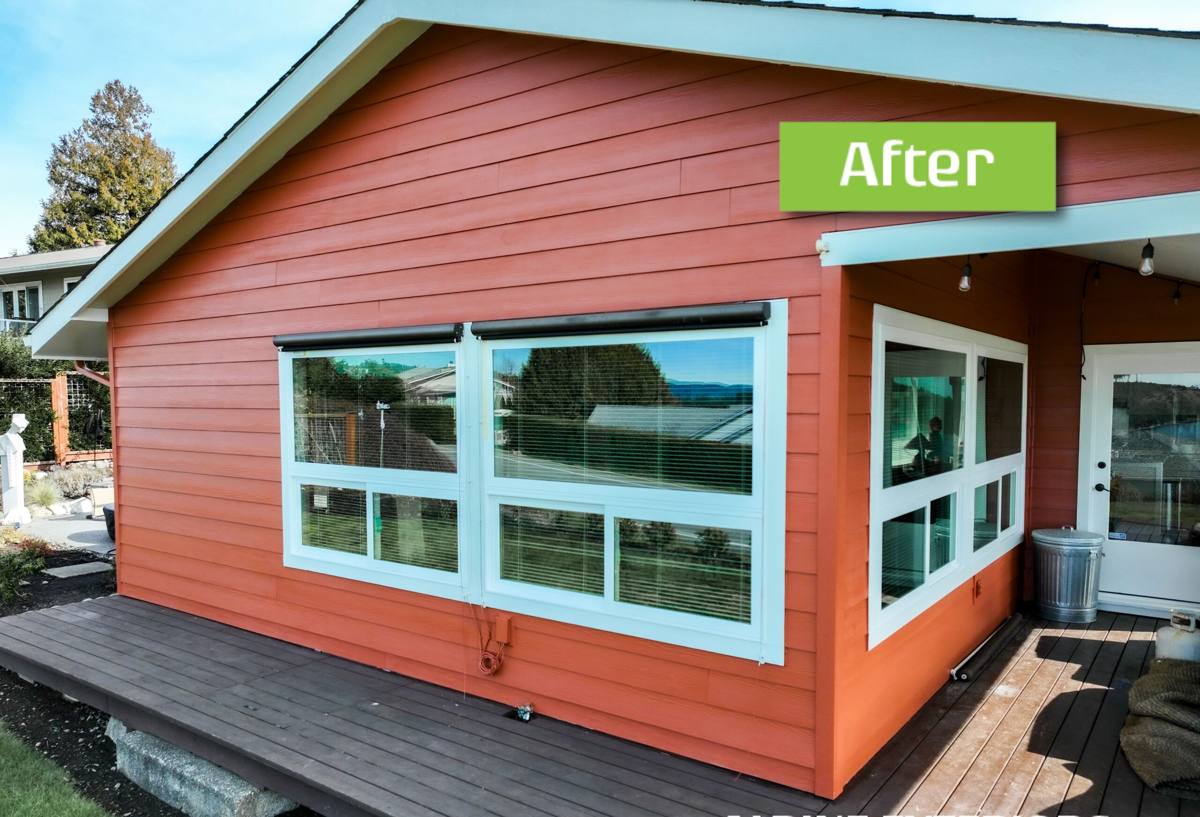
Signs a Window Is Losing the Battle
Most window failures in this area don't show up as a dramatic leak. They show up slowly, and homeowners often assume it's normal aging when it's actually a fixable installation or product issue. Watch for:
- Soft or discolored wood at the bottom corners of the frame or sill, often the first place moss and moisture linger
- Condensation building up between the glass panes, which usually means a failed seal on the insulated glass unit
- Visible daylight or a draft along the frame edge when the window is latched shut
- Paint or finish bubbling on interior trim near the window, a sign moisture is getting behind the casing
- Hardware that's stiff, corroded, or won't latch cleanly, common where salt air reaches window locks and hinges
- A musty smell near the window that gets stronger during wet stretches of the year
Any one of these is worth a look before it turns into framing damage. Wood that's been wet for a season is a different repair than wood that's been wet for three.
What a Correct Installation Actually Involves
It Starts Below the Window, Not At It
The single most important part of a window installation is invisible once the job is done: the sill pan and the flashing sequence. A proper sill pan creates a shallow pool-proof tray under the window unit so that any water that does get past the exterior seal has somewhere to go besides your wall framing. In a climate with as much wind-driven rain as this one, skipping or shortcutting the sill pan is the most common reason a window that looks fine from the street ends up with rotten sheathing behind it.
Flashing Order Matters
Flashing tape and building paper or house wrap have to be layered like shingles, working from the bottom up, so water is always directed outward and downward rather than trapped behind a lap. This is a detail that's easy to get backwards under time pressure, and it's one of the things we check on every install regardless of how simple the job looks.
Sealant Is a Backup, Not the Plan
Caulk and sealant should be the last line of defense, not the primary strategy. A window that relies on a bead of caulk to stay dry will eventually fail once that caulk ages, shrinks, or is exposed to enough freeze-thaw cycling and moss-season dampness. The flashing and drainage path underneath need to work with or without the sealant.
Materials That Hold Up Near the Water
Material choice matters more here than in a drier, inland climate, mainly because of how each option handles sustained moisture exposure and salt air over time.
| Material | How It Handles Salt Air & Moisture | Maintenance Load |
|---|---|---|
| Vinyl | Doesn't corrode or rot; hardware quality varies by manufacturer | Low — occasional cleaning |
| Fiberglass | Very stable in wet, salty conditions; minimal expansion/contraction | Low |
| Aluminum-clad wood | Good exterior protection if cladding seams are sealed correctly; wood interior still needs a dry cavity | Moderate |
| Bare wood | Needs consistent refinishing to resist moss-season moisture and salt exposure | High |
We're upfront with Puget homeowners about this table: bare wood windows can look great, but on a home exposed to driving rain and long damp stretches, they demand a maintenance schedule most people underestimate. Vinyl and fiberglass units, paired with correct flashing, generally give the best balance of appearance and long-term performance for this specific climate without asking the homeowner to repaint every few years.
How We Handle a Window Installation Here
- On-site assessment — we check existing framing, sill condition, and drainage paths before quoting anything, since hidden rot changes the scope
- Removal — old units come out carefully so we can inspect the rough opening and sheathing underneath
- Repair as needed — any soft framing or sheathing gets replaced before a new window ever goes in; installing a new window over damaged framing just hides the problem
- Sill pan and flashing — installed in the correct shingle-lap sequence for this climate's wind-driven rain
- Window set and shim — unit is leveled, squared, and shimmed so it operates smoothly and seals evenly
- Insulation and air-sealing — the gap between frame and rough opening is filled properly, not overpacked or left hollow
- Exterior trim and sealant — finish work and sealant applied as the backup layer, not the primary defense
- Final function and weather check — every unit is opened, closed, and locked to confirm smooth operation before we call the job done
Mistakes We Regularly Find From Rushed Past Installs
A lot of the repair calls we get in Puget aren't about window quality — they're about installation shortcuts. The most common ones:
- No sill pan, or a sill pan installed after the flashing instead of before it
- Flashing taped in the wrong order, directing water inward instead of out
- Caulk used to "fix" a gap that should have been addressed with proper shimming or flashing
- Retrofit windows installed over rotted original frames without checking what was underneath
- Interior trim reinstalled before the wall cavity had a chance to dry, sealing moisture inside
What Affects the Cost
| Factor | Why It Matters |
|---|---|
| Full-frame vs. retrofit (insert) replacement | Full-frame costs more but is often necessary once framing or flashing is compromised |
| Hidden rot or water damage | Not visible until removal; adds framing and sheathing repair to the scope |
| Window count and sizing | Larger or custom-sized units and multi-window jobs affect material and labor pricing |
| Material choice | Vinyl, fiberglass, and wood-clad units carry different upfront costs and long-term maintenance costs |
| Access and elevation | Second-story or hard-to-reach windows take more time and equipment |
We give straightforward, honest ranges once we've actually seen the windows and framing — not a number pulled from a phone call, since hidden rot is common enough here that a quick estimate can be misleading either way.
Why It Helps to Hire a Crew That Already Works Puget
Window installation isn't a one-size-fits-all trade, and a crew that mostly works drier inland areas may not default to the sill pan, flashing sequence, and drainage details that matter most this close to Bellingham Bay. A crew that regularly works Puget and the surrounding Whatcom County area already knows which details can't be skipped, what moss-season moisture does to untreated wood over a few winters, and how salt air shortens the life of the wrong hardware choices. That familiarity shows up as fewer callbacks, not just faster quotes.
It also matters for permitting and code requirements, which can vary by jurisdiction even within the same county — a local crew already knows what's expected without extra back-and-forth that slows the job down.
Living With Your Windows After Install
A correctly installed window still benefits from a little seasonal attention, especially given the moss season here:
- Clear debris and moss buildup from window tracks and weep holes so water can drain as designed
- Check exterior sealant lines once a year for cracking or gaps, particularly after a hard winter
- Wipe down hardware periodically if the home is close enough to the water to catch salt air, since corrosion is easier to prevent than reverse
- Watch for condensation between panes — it's a sign of a failed seal, not something to ignore
If you're noticing drafts, moisture, or aging windows in your Puget home, we're happy to take a look and give you a straight, no-pressure assessment of what's actually going on and what it would take to fix it. There's a free estimate form below whenever you're ready.