 Bellingham
 Why Silver Beach Siding Has to Work Harder
Silver Beach sits close enough to Bellingham Bay that homes here deal with a different mix of weather stress than siding just a few miles inland. Salt-tinged air moves off the water and settles on exterior surfaces year-round. Driving rain off the bay hits walls at an angle instead of falling straight down, which pushes moisture into seams, laps, and trim joints that a calmer rain would never reach. And because much of the neighborhood carries mature tree cover, a long moss and algae season follows — north-facing walls and anything shaded by a fir or cedar canopy can stay damp for days after a storm passes.
None of that is unusual for Whatcom County. But it adds up faster on a home sitting closer to the shoreline. Paint fails sooner. Caulk joints open up. Wood trim softens at the bottom edge before an owner ever notices. Siding that's marginal for the job doesn't fail all at once — it fails one soft spot at a time, usually starting low on the wall or at a corner that catches wind-driven rain.
What James Hardie Is Built to Handle Here
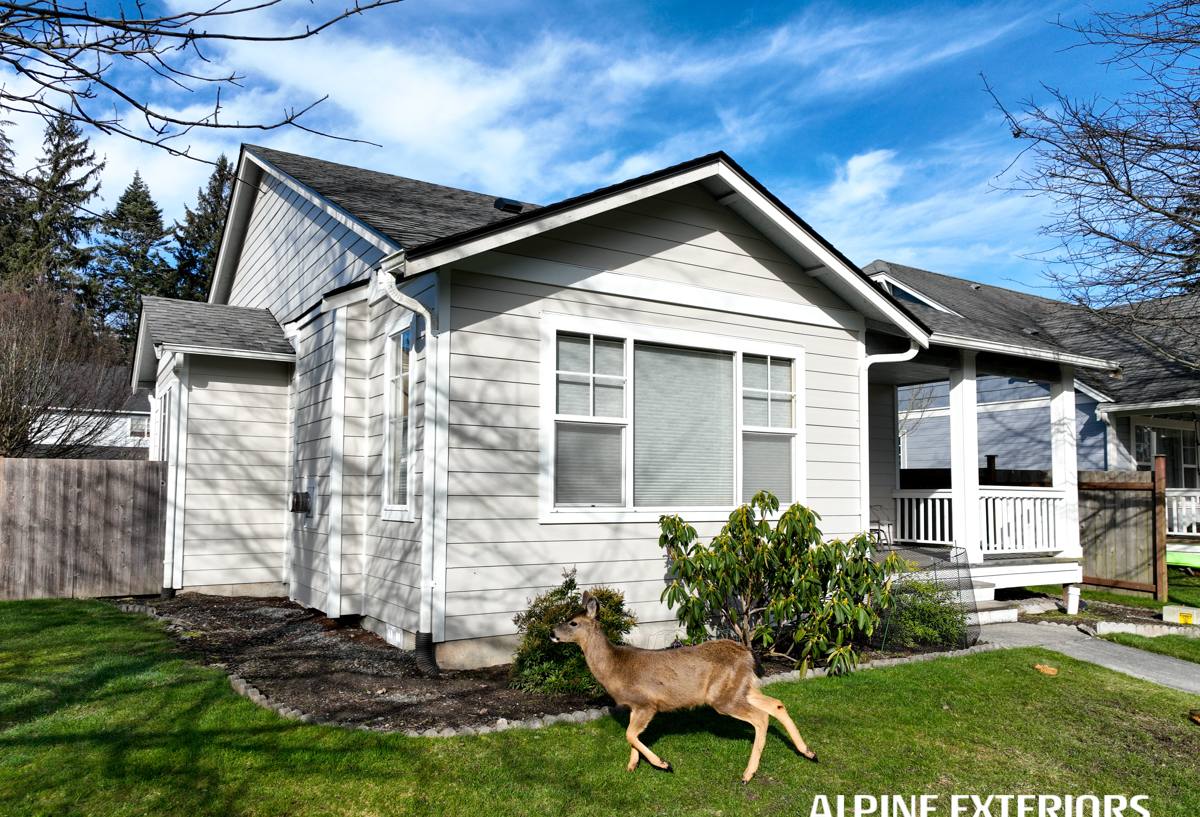
We install James Hardie fiber cement siding exclusively, and in a location like Silver Beach that's not a marketing preference — it's a practical one. Hardie's board is cement, sand, and cellulose fiber, cured into a dense, non-combustible panel that doesn't absorb water the way wood-based products do and doesn't expand and contract the way vinyl does in temperature swings. It doesn't feed moss and algae growth the way bare wood or some engineered wood products can when they stay damp.
James Hardie also builds region-specific product lines, and for the Pacific Northwest that means the HZ5 line, engineered for wetter, more humid climates with freeze-thaw cycles. That's a meaningful distinction from a one-size-fits-all siding product — the board formulation itself is matched to conditions like the ones Silver Beach sees most winters.
ColorPlus Factory Finish
Most of what we install carries Hardie's ColorPlus finish — a factory-applied, baked-on finish rather than field-applied paint. In a salt-air environment, that matters: factory finishes are more consistent and better bonded to the substrate than paint rolled on-site after installation, and they hold color longer against UV and moisture cycling. It won't eliminate all future touch-up needs at cut edges, but it meaningfully extends the time before a homeowner is looking at a repaint.
How Hardie Compares to the Alternatives in This Climate
Homeowners in Silver Beach considering a re-side often ask us to explain, plainly, why we don't offer the cheaper options. Here's the honest comparison based on how each material actually behaves in a salt-air, high-moisture, shaded-lot environment:
| Material | Behavior in salt air & driving rain | Behavior in moss/shade conditions | Long-term trade-off |
|---|---|---|---|
| James Hardie fiber cement | Dense, low water absorption; won't rot or delaminate | Doesn't feed organic growth; surface cleans up well | Higher upfront cost, offset by longevity and warranty |
| Vinyl siding | Won't rot, but panels can warp or bow with heat/cold cycling and gaps at seams let wind-driven rain track behind | Can still host surface algae/mildew, especially in shaded corners | Lowest upfront cost, shortest realistic service life here |
| Primed wood / cedar | Absorbs moisture at end grain and joints; prone to swelling and paint failure | Organic material — moss and algae take hold readily in shade | Needs the most ongoing maintenance of any option |
| LP SmartSide (engineered wood) | Better than raw wood but still wood-based; edge sealing and caulking discipline are critical | Can support growth if finish is compromised | Performance depends heavily on installer diligence at every cut edge |
This isn't a knock on every one of those products in every setting. Vinyl and engineered wood have legitimate uses elsewhere. But for a bay-adjacent, shaded lot with real wind-driven rain exposure, we've standardized on Hardie because it's the product we're comfortable putting our name behind for the next 30-plus years.
What a Correct Installation Actually Involves
Siding performance in a climate like this depends less on the board itself and more on what's underneath it and how it's fastened. This is where a lot of re-side jobs quietly go wrong, and where most future callbacks originate.
The Water-Resistive Barrier
Before a single piece of Hardie goes up, the wall needs a continuous, properly lapped water-resistive barrier (WRB) — house wrap or equivalent — installed shingle-style so water sheds outward and down, never into a seam. Every penetration (outlets, hose bibs, light fixtures) needs to be flashed back into that barrier, not just caulked over the top.
Flashing at Every Transition
Window and door heads, deck ledgers, roof-to-wall intersections, and horizontal trim all need metal or membrane flashing that directs water back out, not behind the siding. Driving rain off the bay finds these transitions first — they're the highest-risk points on the whole wall.
Fastening and Gapping
Hardie specifies exact nailing patterns, fastener types, and clearances (siding-to-grade, siding-to-roofline, board overlap) for a reason: get any of those wrong and the manufacturer's own warranty can be voided, regardless of how good the board itself is. Gaps at butt joints need to be sized correctly and sealed with a flexible, paintable sealant rated for exterior use — not just caulked shut with whatever's on hand.
Trim and Caulking Discipline
Cut edges of any fiber cement board need to be sealed before installation, since raw cut edges absorb moisture differently than the factory-finished face. Skipping that step is one of the most common shortcuts we see on prior installs we're asked to repair.
Our Process for a Silver Beach Home
Every job starts with a walk-around, not a sales pitch. We look at the wall assembly, the current siding's failure points, roofline and gutter behavior, tree cover and shade patterns, and how the home is oriented relative to wind and rain exposure off the bay. That assessment shapes the plan more than any catalog page does.
- Assessment and measure: we document existing damage, moisture intrusion points, and any rot found at sheathing before quoting the job — not after tearing into the wall.
- Tear-off and sheathing check: old siding comes off, sheathing gets inspected and repaired where needed, and we don't cover up soft or damaged sheathing with new siding.
- WRB and flashing installation: a new, continuous water-resistive barrier goes on with proper flashing at every window, door, and penetration.
- Hardie installation: boards, panels, or lap siding installed to manufacturer fastening specs, with sealed cut edges and correctly sized joints.
- Trim, caulk, and touch-up: factory-finish touch-up at cut edges and fasteners, using Hardie-matched touch-up product.
- Final walk-through: we go over the finished work with the homeowner before calling the job done.
Signs an Older Silver Beach Home Needs Attention
A lot of the calls we get in this neighborhood start with one of these signs rather than a full-blown failure:
- Dark staining or green film building up on north- or shade-facing walls that pressure washing only knocks back temporarily
- Paint that's peeling or bubbling in sheets rather than fading evenly, especially near the bottom of the wall
- Soft or spongy trim boards around windows, doors, or where a deck ties into the house
- Visible gaps opening up at siding seams or around trim after a few winters
- Interior signs — a musty smell, discoloration, or soft drywall near an exterior wall — that point to moisture getting past the siding, not just sitting on it
Any one of these on its own isn't necessarily an emergency, but they're worth a professional look before the next wet season rather than after.
What Homeowners Can Do Between Professional Checks
Correct installation and material choice do most of the work, but a small amount of upkeep extends the life of any siding — Hardie included:
- Rinse siding gently once or twice a year, especially shaded walls, to keep moss and algae from establishing — a garden hose is usually enough; avoid aggressive pressure washing directly at seams
- Keep gutters clear so overflow doesn't run down the wall face repeatedly in the same spot
- Trim back branches and shrubs that keep a section of wall shaded and damp longer than the rest of the house
- Walk the exterior once a year and look at caulk joints, trim corners, and anywhere siding meets a different material (deck, chimney, foundation) for gaps or cracking
- Touch up any nicked or chipped finish promptly rather than letting a small exposed spot sit through a wet winter
Cost Factors for a Silver Beach Re-Side
Every home is different, but the main variables that move a project's cost are consistent. We won't quote a number without seeing the house, but this is what actually drives the price:
| Factor | Why it matters |
|---|---|
| Sheathing condition underneath old siding | Rot or damage found during tear-off needs repair before new siding goes on — this is the most common source of a mid-project cost adjustment |
| Home size and wall complexity | More corners, dormers, and trim transitions mean more labor and material per square foot than a simple rectangular wall |
| Product line and profile chosen | Lap siding, shingle-style panels, and board-and-batten carry different material and labor costs |
| Existing siding removal | Tear-off of old wood, vinyl, or a prior fiber cement job adds labor time before the new install can start |
| Access and site conditions | Steep grades, tight lot lines, or limited staging space near the water can affect scaffolding and logistics |
Why the Crew Matters as Much as the Product
Hardie siding installed with shortcuts performs like a cheaper product — the manufacturer's own warranty depends on correct installation, and the real-world durability we've described above assumes the WRB, flashing, and fastening were done right the first time. A crew that regularly works Whatcom County waterfront and near-waterfront neighborhoods has already seen how wind-driven rain and shaded, moss-prone walls behave differently from a typical inland lot, and builds the install around that rather than treating every job the same way. That local pattern recognition — knowing which corners of a Silver Beach home take the worst of the weather before the first board goes up — is worth as much as the material specification itself.
If your siding is showing wear, or you're planning ahead for a re-side, we're happy to take a look and give you a straightforward, no-pressure estimate — no invented urgency, just an honest read on what your home needs.