 Bellingham
 Happy Valley's Climate Is Tougher on Decks Than It Looks
Happy Valley sits close enough to Bellingham Bay that salt-laden air is a real factor in how exterior materials age here, and it gets the same steady, driving rain that soaks the rest of Whatcom County from fall through spring. Add mature tree cover on many lots and you get long stretches where a deck simply doesn't dry out between storms. That combination — moisture, salt, and shade — is exactly the environment that wears out an ordinary deck fastest, and it's why the right decking choice and the right build details matter more here than they would in a drier climate.
A deck in this neighborhood isn't judged by how it looks the first summer. It's judged by how it holds up after five or ten wet seasons of standing water, moss creep, and freeze-thaw cycles working on every joint, fastener, and board edge. That's the standard we build to.
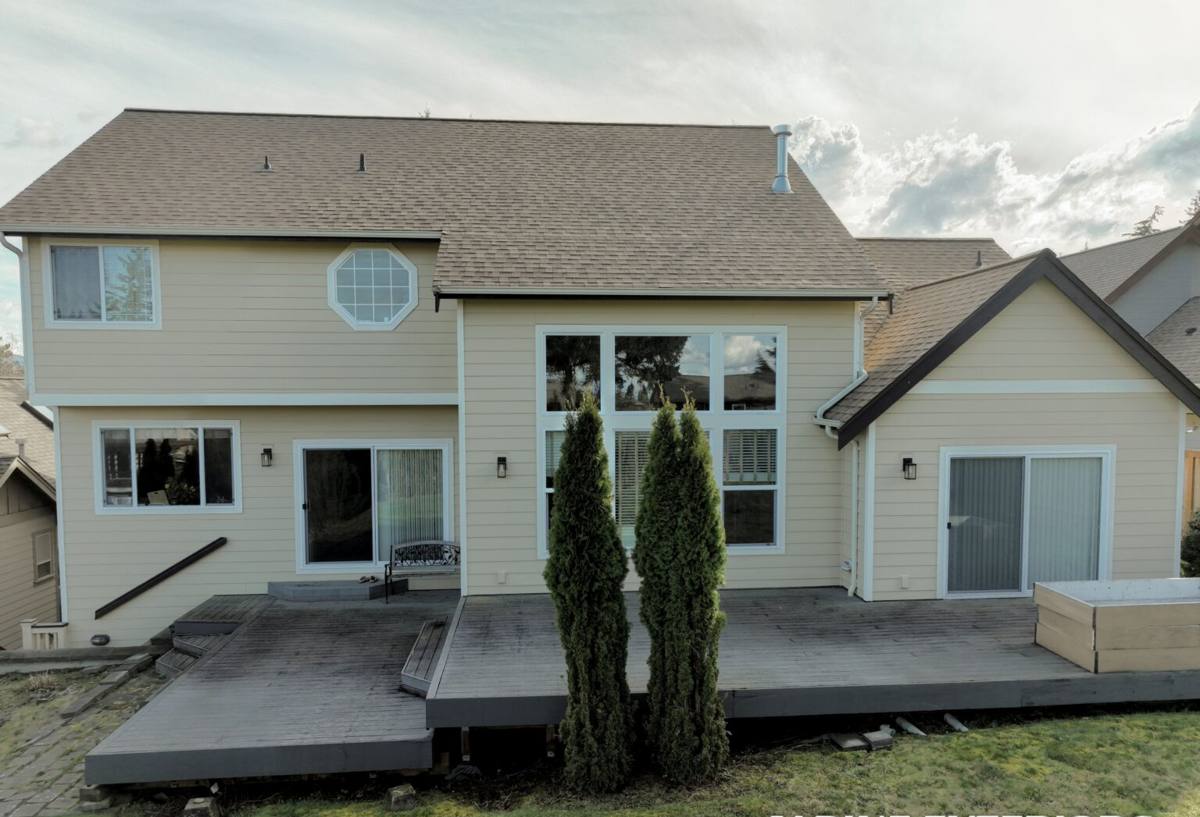
Why Composite Decking Makes Sense for This Neighborhood
Wood decking has to be sealed or stained on a schedule to keep water out of the grain, and in a climate this wet, that schedule slips fast. Skip a year and moisture gets into the fibers, and once wood decking stays damp for long stretches it starts graying, splintering, and hosting the moss and algae that thrive in Pacific Northwest shade. Composite decking solves the core problem: the boards themselves don't absorb water and feed organic growth the way bare wood does, so a well-installed composite deck holds its surface and color with far less annual upkeep.
That doesn't mean composite decking is maintenance-free — nothing exposed to Bellingham's climate really is — but it changes what maintenance looks like. Instead of sanding, stripping, and restaining, you're mostly rinsing off pollen, needles, and the occasional moss film before it gets a grip.
What "Composite" Actually Means
Composite decking is a blend of wood fiber and plastic, formed into boards. There are two broad categories worth understanding before you choose a product:
- Capped composite — the board has a plastic outer shell wrapped around the wood-plastic core, which is what actually blocks moisture and staining at the surface.
- Uncapped composite — no protective shell, so the surface is more exposed to moisture absorption and staining over time, particularly in a wet climate like this one.
For Happy Valley homes, we default to recommending capped boards. The extra moisture protection at the surface is doing real work in a climate that rarely gives a deck more than a few dry days in a row for much of the year.
What a Correct Composite Deck Installation Involves
The boards get most of the attention, but the framing underneath is what actually determines whether a deck lasts fifteen years or needs rebuilding in five. This is where we see the biggest gap between a deck that was installed correctly and one that was just put together to look finished.
The Substructure Matters More Than the Decking Itself
A correct build in this climate includes:
- Pressure-treated or naturally durable framing lumber, sized and spaced to the composite manufacturer's specification — composite boards typically need tighter joist spacing than wood decking, especially on diagonal layouts.
- Proper ledger board flashing where the deck attaches to the house, so water is directed away from the wall structure instead of tracking behind the siding.
- Joist tape or another moisture barrier on top of the framing, protecting the wood from the underside where composite boards trap moisture against it.
- Correct fastener spacing and gapping between boards, which allows the deck to drain and lets air move underneath rather than holding water against the frame.
- Adequate slope away from the house and clear ventilation underneath, so the space below the deck can actually dry out between rain events instead of staying damp year-round.
Skip any of these and you can still end up with a deck that looks right for a year or two while the frame underneath is quietly rotting or trapping moss-feeding moisture — the exact failure mode composite decking is supposed to prevent.
Composite vs. Wood vs. Pressure-Treated: How They Hold Up in This Climate
| Factor | Composite (capped) | Cedar / Wood | Pressure-Treated Lumber |
|---|---|---|---|
| Moisture absorption | Low — sealed surface resists water pickup | High — needs sealing to control it | Moderate — treatment resists rot, not surface moisture |
| Moss and algae resistance | Good on the surface; still needs periodic cleaning in shade | Poor without regular sealing and cleaning | Poor — rough surface holds moisture and debris |
| Annual maintenance | Occasional wash-down | Sealing or staining, typically every 1-2 years here | Sealing recommended periodically to control checking |
| Salt air exposure | Handles it well; fasteners are the main concern | Accelerates graying and surface breakdown | Accelerates fastener corrosion and surface wear |
| Upfront cost | Higher material cost | Moderate | Lowest |
| Long-term cost | Lower over the life of the deck due to reduced upkeep | Higher — labor and materials for repeated sealing | Moderate — shorter surface life, more frequent repair |
Pressure-treated lumber still has its place, particularly for the structural frame itself, where it's standard and cost-effective. Where it struggles is as a walking surface in a climate this wet — it's more prone to splintering, checking, and holding the moisture that feeds moss growth than a capped composite board is.
Moss, Algae, and Salt Air: What to Realistically Expect
No decking material is immune to moss in a climate that stays damp and shaded for months at a time, and it's honest to say that up front. Composite decking resists moss taking root in the material itself the way wood does, but a fine layer of organic film can still build up on the surface of any deck that sits in shade and gets rained on regularly — that's a surface-cleaning issue, not a sign the material is failing.
A few things make a real difference in how much of that you deal with:
- Board texture — a slightly textured composite surface sheds moss film more easily during cleaning than a very smooth one, which can stay slick.
- Sun exposure — north-facing decks and areas under heavy tree canopy will need more frequent rinsing than open, south-facing sections.
- Gap spacing and airflow underneath — a deck that drains and breathes properly dries out between storms faster than one sitting over stagnant, poorly ventilated space.
- Fastener material — stainless or coated fasteners resist the corrosion that salt air accelerates on lower-grade hardware, which matters for board-to-frame connections over time.
None of this is a reason to avoid composite decking — it's the reason we build the framing, drainage, and fastener choices around the actual conditions of this specific site rather than treating every deck the same regardless of exposure.
Our Process for a Happy Valley Composite Deck
- On-site assessment. We look at sun exposure, tree cover, drainage patterns, and how the deck ties into the house before recommending a layout or board type.
- Framing evaluation or rebuild. If we're replacing an existing deck, we check whether the substructure is sound enough to reuse or whether it needs to come out — reusing a compromised frame under new composite boards just hides the problem, it doesn't fix it.
- Material selection. We walk through board options and fastening systems based on the deck's exposure, not just the homeowner's color preference, though color and style absolutely factor in too.
- Installation. Proper flashing, joist protection, spacing, and hidden or exposed fastening done to manufacturer spec, so the warranty stays valid and the build performs the way it's supposed to.
- Final walkthrough and care guidance. We explain what routine care actually looks like for the specific product installed, so there are no surprises about upkeep down the road.
Signs Your Current Deck Needs Replacing, Not Just Cleaning
Homeowners often ask whether a tired-looking deck can be saved with a good cleaning or a new coat of stain. Sometimes it can. But a few warning signs mean the problem is structural, not cosmetic:
- Soft or spongy spots when you walk across the boards
- Visible gaps or rot at the ledger board where the deck meets the house
- Fasteners that are rusted, popped up, or pulling through the wood
- Persistent moss or dark staining that returns within weeks of cleaning
- Boards that are cupping, splitting, or noticeably darker on the underside than the top
- Railings or posts that feel loose or flex under normal pressure
If any of those apply, it's worth having someone look at the framing before spending money on surface repairs that won't hold.
Why It Matters That We Already Work in Happy Valley
A lot of composite decking problems we get called to fix weren't caused by the material — they were caused by a build that didn't account for local conditions. A crew that regularly works in and around Bellingham knows how much shade a given lot typically holds through the winter, how the framing needs to be handled to deal with sustained rain rather than occasional showers, and where salt air exposure actually becomes a fastener and hardware concern versus where it's a non-issue further inland.
That local familiarity also carries over into permitting and inspection expectations for Whatcom County and the City of Bellingham, so the project moves without avoidable delays. It's the difference between a deck that was built to a generic spec sheet and one that was built for the specific way weather behaves on this side of the county.
Get a Straightforward Estimate
If you're weighing a new composite deck or replacing one that hasn't held up to Happy Valley's weather, we're happy to take a look and give you an honest read on the framing, the right materials for your site's sun and moisture exposure, and a clear estimate — no pressure, no hard sell. Use the form below to get started.