 Bellingham
 Ferndale Roofs Take a Specific Kind of Beating
Ferndale sits close enough to the water and open farmland that roofs here deal with a different mix of stress than roofs twenty miles inland. Wind off the Strait and the lowland corridors around Whatcom County doesn't just gust — it comes in sustained pushes during winter storms, working at loose shingle tabs and flashing edges for hours at a time. Add driving rain that hits siding and roof edges nearly sideways, salt-tinged air drifting in off the water that slowly works on exposed metal, and a moss season that runs long into the year on north-facing slopes, and you've got a roof that ages differently than one in a drier climate. Storm damage repair out here isn't just "patch the hole" work. It's repair that has to hold up against the next round of the same weather, not just look fixed for a season.
We're a Bellingham-based crew that works Ferndale regularly, not a call center that dispatches whoever's closest. That matters more than people expect once you get into the details below.
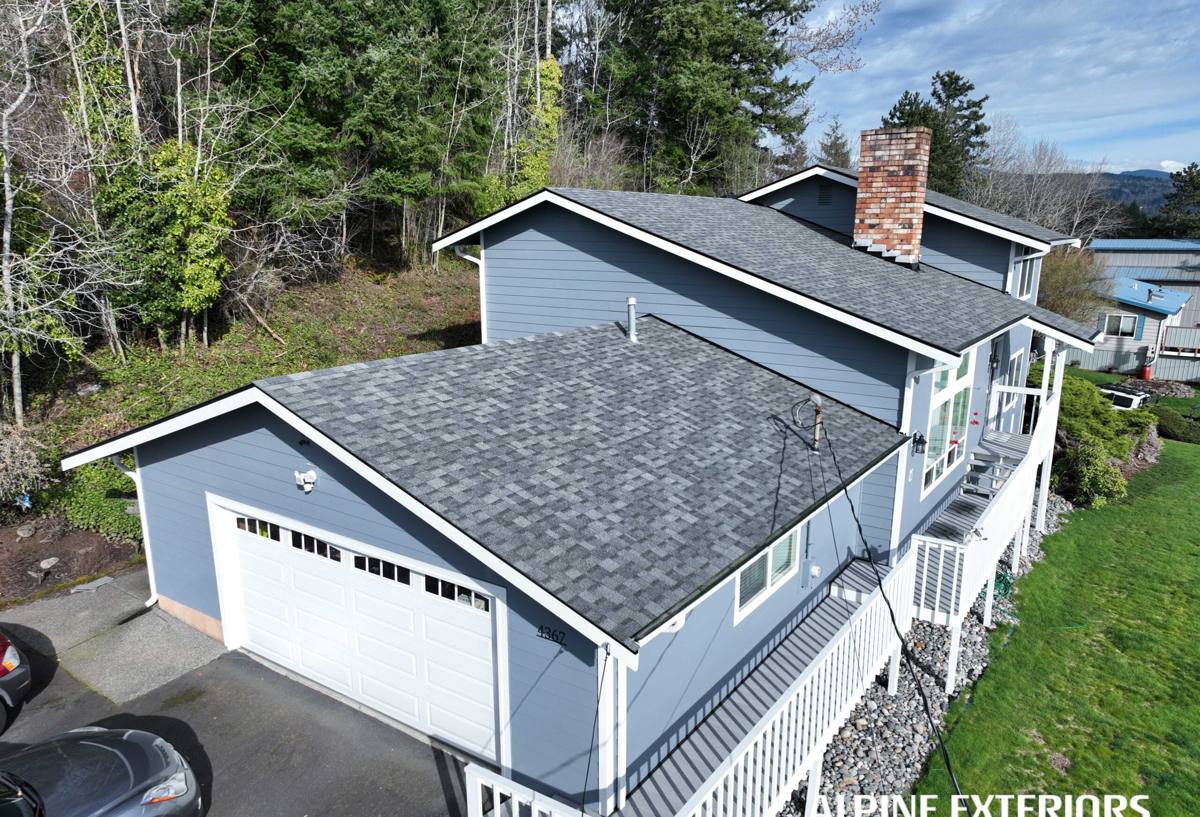
What Actually Counts as Storm Damage
Homeowners often assume storm damage means a hole or missing shingles, but a lot of the damage we get called out for is quieter than that. Knowing the range helps you catch problems before they turn into interior leaks.
- Wind-lifted or creased shingles — tabs that got pushed up and re-seated wrong, breaking the seal strip even though nothing is visibly missing
- Flashing displacement — around chimneys, skylights, and roof-to-wall transitions, where wind and repeated wet-dry cycling work fasteners loose
- Granule loss from heavy, wind-driven rain, which shows up as bald patches and accelerates UV wear underneath
- Impact damage from limbs and debris — common where mature trees overhang a roofline, which describes a lot of Ferndale lots
- Gutter and downspout separation, which redirects water into fascia and soffits instead of away from the house
- Ridge cap and hip damage, often the first thing to go in a sustained windstorm because it takes the most direct uplift
Some of this is visible from the ground. Some of it isn't, which is why a post-storm inspection is worth doing even when nothing looks obviously wrong.
Why Acting Fast Actually Matters Here
In a drier climate, a small storm-damaged spot can sit for a few weeks without much consequence. In Whatcom County's rain pattern, it can't. Once a seal is broken or flashing is lifted, every subsequent rain event pushes water further into the deck and insulation. Combine that with our extended damp season and you get conditions where hidden moisture doesn't dry out between storms — it just accumulates. That's how a repairable shingle problem turns into rotted decking, and eventually into interior drywall and insulation damage that costs far more than the original fix.
This is also where a local crew has a real advantage over an out-of-area outfit: we can usually get a tarp on an active leak same-day or next-day, because we're not driving in from Seattle or Everson. Emergency tarping isn't a fix, but it stops the bleeding while the repair is scoped correctly instead of rushed.
Signs You Shouldn't Wait On
- A ceiling stain that appears within a day or two of a windstorm
- Shingles or shingle pieces in the yard or gutters after high wind
- Visible daylight or gaps around chimney or vent flashing
- A gutter section hanging loose or pulled away from the fascia
- Granules collecting at downspout outlets in noticeably higher amounts after a storm
What a Correct Storm Repair Actually Involves
A lot of storm repair work in this region gets done wrong not through bad intent, but through rushing. A crew slaps a few shingles down, caulks a flashing seam, and calls it done. That kind of fix might survive a dry summer. It usually doesn't survive the following winter.
Matching, Not Just Covering
Shingle repairs need to match the existing course lines and, as closely as possible, the existing product — mismatched granule color and profile height are cosmetic issues now, but mismatched materials also age at different rates, which shows up worse over time. If your roof is old enough that exact shingle matches aren't available, we'll tell you that honestly rather than force a mismatch and pretend it's invisible.
Flashing Done Properly, Not Just Sealed
Caulk over a flashing gap is a temporary answer, not a repair. Correct flashing work means re-seating or replacing the metal so water sheds over it the way it's designed to, with sealant used to back up the mechanical work — not substitute for it.
Underlayment Integrity
Any repair that opens up a section of roof is a chance to check the underlayment underneath. In our climate, we lean toward self-adhering ice-and-water membrane at eaves, valleys, and any repair zone that sees concentrated water flow, because standard felt alone doesn't hold up as well against the amount of wind-driven rain this area sees.
Deck Condition
If plywood decking is soft, delaminated, or stained from prior moisture, patching shingles over it just hides a structural problem. Part of an honest repair scope is telling you when a section of deck needs replacing rather than covering it.
Our Process
- Inspection and documentation. We walk the roof (or use a pole camera where pitch or safety makes that unsafe) and photograph damage clearly enough to support an insurance claim if you're filing one.
- Emergency stabilization if needed. Tarping or temporary flashing to stop active water intrusion before the full repair is scheduled.
- Written scope and honest options. We tell you what's a targeted repair, what's a larger section replacement, and what's genuinely optional versus necessary — no scope-padding.
- Repair execution using materials matched to your existing roof system wherever possible, with flashing and underlayment done to hold up through another Whatcom County winter, not just pass a visual check.
- Final walk-through so you can see the completed work and ask questions before we consider the job done.
Storm Damage and Insurance: What to Know Going In
Most homeowner policies cover sudden, storm-caused damage — wind, falling limbs, hail where it occurs — but they don't cover damage that resulted from years of deferred maintenance or an already-failing roof. Adjusters distinguish between the two, and documentation from the actual repair crew carries weight in that conversation. We're not a public adjuster and won't pretend to be one, but we can give you a clear, dated, photographed account of what the storm did versus what was pre-existing wear, which is exactly what a claim needs to move smoothly.
| Factor | Likely Insurance-Covered | Typically Owner Responsibility |
|---|---|---|
| Wind-torn shingles from a named storm event | Usually yes | — |
| Limb impact during a windstorm | Usually yes | — |
| Gradual granule loss from age | Rarely | Usually |
| Moss-related shingle degradation over years | Rarely | Usually |
| Flashing that was already failing before the storm | Sometimes, case by case | Sometimes |
| Interior damage from a leak reported promptly | Often, if reported quickly | Risk increases the longer it's left |
Why a Crew That Already Works Ferndale Is Worth Choosing
Storm response is one of the few areas of roofing where local presence isn't a marketing point — it's operationally real. A crew based in Bellingham that already runs jobs in Ferndale knows which roof pitches and orientations in this area tend to take wind damage first, has a shorter drive for emergency tarping, and isn't learning the regional moss and moisture pattern from scratch. We're not guessing at how Whatcom County weather behaves; it's what we deal with on every job. That translates into fewer surprises in the repair scope and faster turnaround when a storm hits multiple properties in the same window.
Reducing the Chance of Repeat Damage
A storm repair is a good moment to address the conditions that made your roof vulnerable in the first place, especially moss buildup and gutter performance — both chronic issues in this climate.
- Clear moss buildup and treat north-facing slopes before it lifts shingle edges and holds moisture against the roof surface
- Confirm gutters and downspouts are securely fastened and pitched correctly — loose gutters are often the first thing to fail in the next windstorm
- Trim back tree limbs that overhang the roofline where practical
- Check attic ventilation — poor airflow speeds up moss growth and deck moisture problems from the inside
- Have flashing points (chimneys, skylights, wall transitions) checked annually, since these are the most common recurring failure points in wind events
What Drives the Cost of a Storm Repair
We won't quote a number without seeing the roof, but the scope of most storm repairs comes down to a handful of factors.
| Factor | Why It Matters |
|---|---|
| Size of the damaged area | A few shingles versus a full slope changes labor and material scope significantly |
| Roof pitch and access | Steeper or harder-to-access roofs take longer and require more safety setup |
| Age and condition of surrounding roofing | Older roofs may need broader work if surrounding shingles are too brittle to tie into cleanly |
| Underlying deck condition | Rotted or soft decking discovered during repair adds material and labor |
| Material availability | Exact shingle matches for older roofs can affect cost and timeline |
If your roof in Ferndale has taken storm damage — or you're not sure whether what you're seeing is storm-related or just normal wear — we're happy to come take an honest look. The estimate is free, there's no pressure attached to it, and you'll get a straight answer about what's actually needed. Use the form below to get started.