 Bellingham
 Why Happy Valley Decks Wear Out Faster Than the Manual Says
Every deck manufacturer prints a maintenance schedule that assumes a fairly dry, even climate. Happy Valley doesn't get one of those. Sitting close enough to Bellingham Bay to catch salt-laden air, and tucked into a hilly, tree-shaded part of town, the neighborhood combines three things that are individually hard on wood and framing — and brutal in combination: salt air, driving rain, and a moss season that can run eight months or longer.
Salt air accelerates corrosion in fasteners, joist hangers, and any exposed metal flashing long before most homeowners notice a problem on the surface. Driving rain — rain that comes in sideways off the water rather than falling straight down — gets pushed under flashing, behind ledger boards, and into end-grain cuts that a standard vertical-rain detail was never built to handle. And moss, which thrives in the shade from mature trees common on Happy Valley's sloped lots, holds moisture against decking boards and stair treads for weeks at a time, which is exactly the environment rot fungus needs to get established.
None of that means a deck in this neighborhood is doomed. It means the repair has to account for what's actually happening here in Whatcom County, not what a generic maintenance guide assumes.
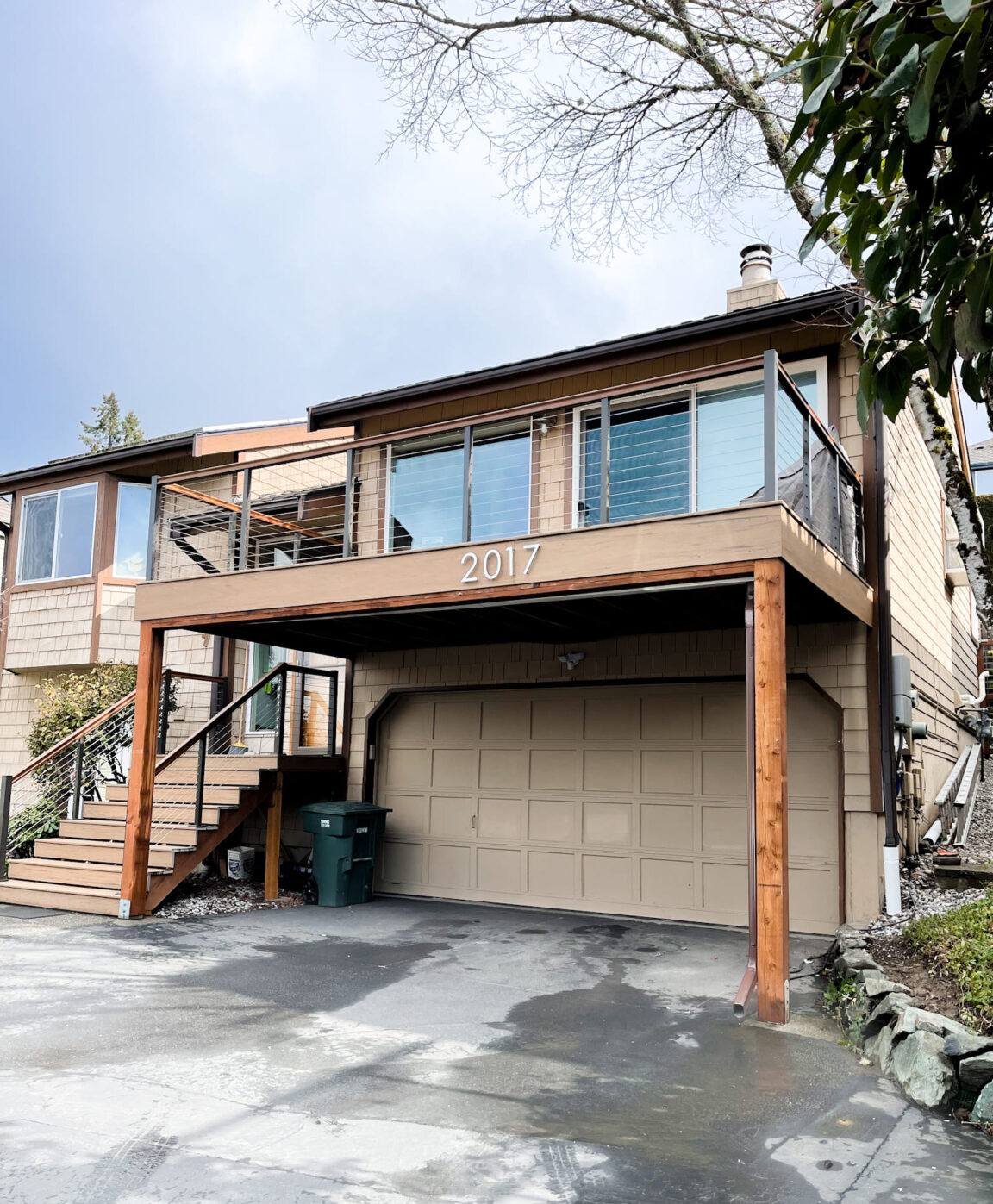
Signs Your Deck Needs Repair, Not Replacement
Most decks we look at in Happy Valley don't need to be torn out — they need the right sections replaced and the underlying causes addressed. Here's how to tell the difference before you call anyone:
Repair territory
- Soft or spongy spots in a few boards, while the framing underneath still probes firm
- Rust streaking from fasteners or hangers, without the wood around them crumbling
- Moss and algae buildup on the surface with no soft decking beneath it
- A wobbly rail post or loose stair stringer that's isolated to one section
- Gaps or separation at the ledger board where it meets the house, caught early
Replacement territory
- Rot that's spread through multiple joists or beams, not just decking boards
- A ledger board connection that's been compromised for years and let water into the rim joist
- Structural movement — visible sag, bounce, or a deck that's pulled away from the house
- Framing installed without proper flashing from the start, now failing in more than one spot
The honest answer is usually somewhere in between: repair the framing where it's sound, replace what's not, and fix the water management details so you're not back here in three years.
What a Correct Deck Repair Actually Involves
A repair that only replaces the boards you can see is a cosmetic fix, not a structural one. In a climate like ours, the parts you can't see are usually where the real problem started.
Ledger board and flashing
The ledger board — where the deck attaches to the house — is the single most common failure point we find in this region, because it's the hardest spot for driving rain to drain away from. A correct repair means pulling decking back far enough to inspect the ledger, the flashing above it, and the rim joist behind it, not just caulking the visible gap and moving on.
Joists, hangers, and fasteners
Salt air corrodes galvanized hardware faster than it does further inland. If your deck is more than 10-15 years old, we check joist hangers and structural screws for rust and pitting, not just visible failure, and upgrade to stainless or heavy-coated hardware where the exposure calls for it.
Ventilation underneath
Moss and rot both need moisture that lingers. A deck built low to the ground or boxed in on the sides traps damp air underneath, which keeps joists wet long after a storm passes. Part of a proper repair is making sure air can actually move through that space.
Surface boards and stairs
Stairs take the most direct water exposure of any part of a deck and wear out first — they're also the highest consequence if a tread fails. We treat stair repair as its own scope, not an afterthought tacked onto the deck surface work.
Repair vs. Replace: Weighing the Real Cost Factors
This is the question almost every homeowner asks, and the honest answer depends on how far the damage has spread and what's underneath.
| Factor | Favors Repair | Favors Full Replacement |
|---|---|---|
| Framing condition | Joists and beams probe solid | Rot has reached multiple structural members |
| Age of deck | Under 15 years, built to a reasonable standard | Original construction lacked proper flashing or hardware |
| Extent of damage | Isolated to a few boards or one section | Damage is spread across the whole structure |
| Ledger connection | Sound, or a contained fix | Long-term water intrusion into the house rim joist |
| Budget timeline | Lower cost now, targeted fix | Higher upfront cost, resets the clock on the whole deck |
As a rule of thumb, if less than a third of the structure is compromised, repair is usually the more sensible investment. Past that point, you're often paying to patch a deck that needs a full rebuild within a few years anyway — and we'll tell you that plainly rather than stack repairs on a structure that's past the point of it being worth it.
How We Approach a Deck Repair Job
1. Full inspection, not a surface look
We probe decking, joists, the ledger connection, and hardware — not just the boards that look bad from a distance. This is where we scope what's actually repair versus what's failed structurally.
2. Written scope before any work starts
You get a clear breakdown of what's being repaired, what's being replaced, and why — no vague line items and no surprises once boards start coming up.
3. Address the water source, not just the symptom
If a ledger board rotted because flashing was missing or a downspout was dumping water onto the deck, we fix that cause as part of the repair. Replacing wood without fixing the water path just buys you a few more years before the same problem comes back.
4. Match materials and fasteners to the exposure
Repairs use hardware and flashing rated for the corrosion and moisture load this area actually sees, not whatever was on hand when the deck was first built decades ago.
5. Clean handoff
We walk you through what was fixed, what to watch, and what basic upkeep will get you the most life out of the repair.
Decking Material Choices for This Climate
What you repair or replace boards with matters as much as the repair itself.
Pressure-treated wood
Lower upfront cost and easy to source, but it needs real maintenance — cleaning, sealing, and periodic inspection — to hold up against moss and driving rain. It's a good fit if you're willing to stay on top of that upkeep.
Cedar
Naturally more rot- and insect-resistant than treated pine, and it holds up well in the Pacific Northwest when it's detailed correctly, but it still needs sealing to fight moss staining and UV graying over time.
Composite decking
Higher material cost, but it doesn't absorb water the way wood does, which matters a lot in a moss-heavy, shaded environment. The trade-off is that composite still needs cleaning to prevent surface algae, and installation has to account for expansion and drainage differently than wood — get that wrong and you trade one maintenance headache for another. We'll walk you through what fits your budget and how much upkeep you actually want to take on, rather than pushing one product as the automatic answer.
Keeping a Repaired Deck From Needing Repair Again
A good repair buys you years, not decades, if the deck isn't looked after afterward. This is the maintenance rhythm that actually matters in Whatcom County's climate:
- Sweep leaves and debris off the deck surface before the fall rains set in — trapped leaves hold moisture and speed up moss growth
- Clean moss and algae off boards and stairs at least once a year, ideally before it's had all winter to establish
- Check that gutters and downspouts aren't draining directly onto the deck or ledger area
- Reseal wood decking on the schedule the product calls for — don't wait for graying or splitting to show up
- Look underneath once a year for standing water, blocked airflow, or early rust on hardware
- Address soft boards or loose rail connections as soon as you notice them, before the damage spreads to framing
Why It Helps to Hire a Crew That Already Works Happy Valley
A deck repair crew that mostly works other parts of Whatcom County or drives in from further away isn't wrong about general carpentry — but they haven't necessarily seen how this specific neighborhood's mix of tree cover, sloped lots, and bay-adjacent salt exposure plays out on a deck over ten or fifteen years. A crew that's worked Happy Valley regularly recognizes the failure patterns faster, knows which details tend to get skipped on older builds in the area, and doesn't have to relearn the local conditions on your job. That usually means a more accurate first inspection and fewer surprises once the work is underway.
Get an Honest Look at Your Deck
If your deck has soft spots, rust streaks, stubborn moss, or just feels like it's due for an honest inspection, we're glad to come take a look. The estimate is free, there's no pressure to sign anything on the spot, and you'll get a straight answer about whether you're looking at a repair or something bigger — use the form below to get started.