 Bellingham
 Why Birchwood Roofs Take a Different Kind of Beating
Birchwood sits close enough to Bellingham Bay and the Puget Sound air mass that homes here deal with a rougher combination of weather than a lot of inland Whatcom County neighborhoods. Salt-laden air corrodes exposed metal faster than it would forty miles east. Driving rain off the Sound doesn't just fall straight down — wind pushes it sideways and up under laps in flashing and shingles that were never designed to shed water horizontally. And because Bellingham's roofs spend a good chunk of the year shaded, damp, and cool, moss and moisture-loving growth get a long runway to establish themselves on north-facing slopes and anywhere tree cover blocks the sun.
None of that means Birchwood roofs fail faster than average. It means the failure points are specific, and a repair that doesn't account for them tends to come back. A patch that would hold for a decade in a drier climate can leak again in eighteen months here if the underlying cause — trapped moisture, a corroding fastener, a moss mat holding water against the deck — isn't addressed along with the visible symptom.
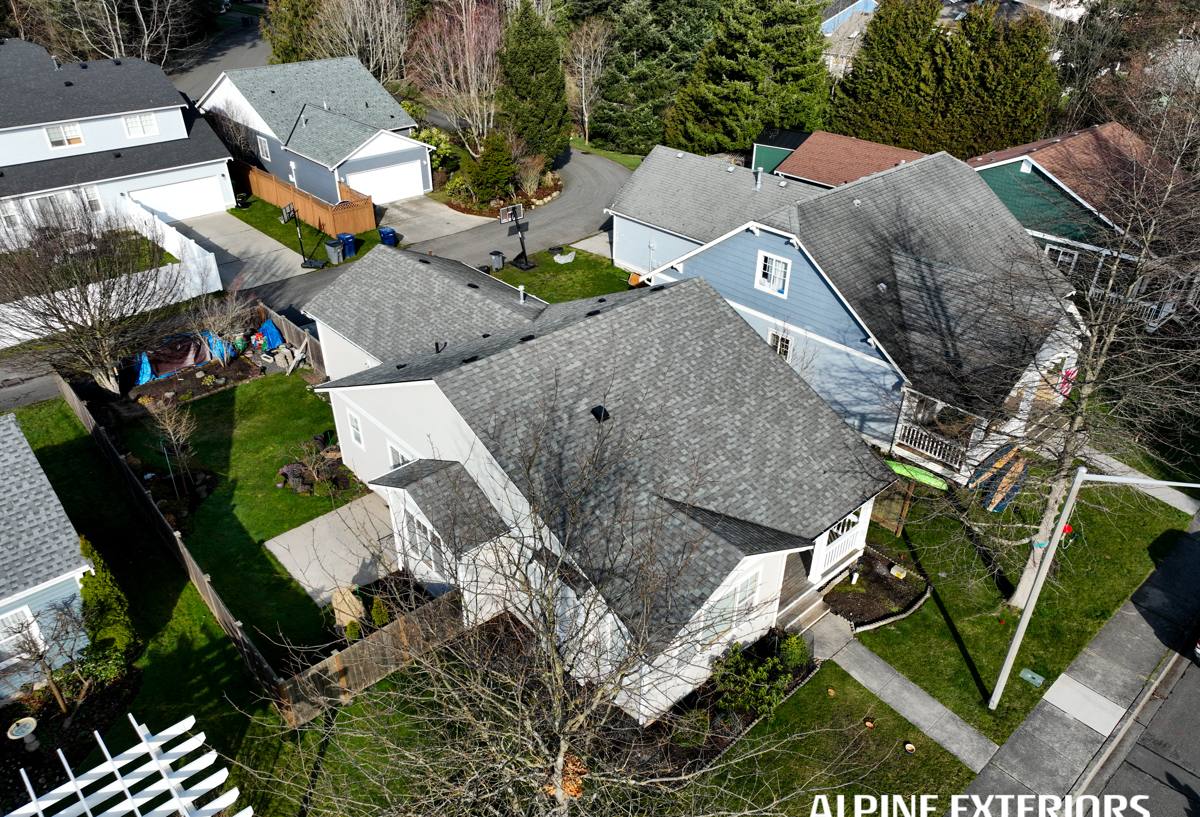
Signs Your Birchwood Roof Needs Repair, Not Replacement
Most roofs give warning signs well before a full leak shows up inside the house. Catching them early is usually the difference between a repair bill and a replacement bill.
- Dark streaking or thick moss growth concentrated on shaded or north-facing sections
- Granules collecting in gutters or at downspout outlets, a sign asphalt shingles are wearing thin
- Soft spots underfoot when walking the roof, indicating deck rot beneath the surface
- Rust staining, lifted edges, or gaps around chimney, vent, and skylight flashing
- Water stains on interior ceilings that appear or worsen only during heavy wind-driven rain
- Shingles that are cracked, curling at the edges, or missing after a windstorm
- Sagging or uneven rooflines, which point to structural rather than surface issues
If what you're seeing is limited to one or two of these, in one area of the roof, a targeted repair is usually the right call. Widespread granule loss, multiple leak points, or a roof already past its expected service life are signs a repair would just be delaying a replacement — and we'll tell you that plainly rather than sell a patch we don't believe in.
What a Correct Roof Repair Actually Involves
Diagnosis before anything gets touched
A repair that starts with "let's replace what's visibly damaged" without tracing the leak to its actual source is a repair that's guessing. Water on a roof rarely travels straight down — it follows the underlayment, deck seams, and rafters sideways before it shows up as a ceiling stain, sometimes several feet from where it entered. A correct repair starts by tracing the path, not just patching the drip point.
Flashing gets the same attention as the shingles
In our experience, flashing failure causes more Birchwood roof leaks than worn-out shingle field does. Chimney flashing, skylight curbs, valley metal, and the step flashing along dormers and walls are all points where two roof planes or materials meet — and every one of those joints is a place wind-driven rain can be pushed against, rather than off of, the roof. Salt air accelerates corrosion on lower-grade or aging metal flashing, so a repair in Birchwood often means replacing flashing sections even when the surrounding shingles are still in decent shape.
Moss and debris removal, done without damaging the surface
Moss holds moisture against roofing material and, on asphalt shingles, can lift the tabs as it grows underneath them. Removing it correctly means clearing it without dragging or scraping in a way that strips granules or cracks aged shingles — pressure washing a mossy asphalt roof, for instance, does more harm than good. We clear growth by hand or with low-pressure methods suited to the material, then treat the area to slow regrowth rather than just knocking moss off and leaving the roof as vulnerable as before.
Matching materials, not just covering the hole
Repairs on an older roof need shingles, flashing profiles, or metal roofing panels that match the existing material closely enough to shed water the same way the original installation did. A mismatched patch can look fine and still create a new water path.
Moss, Moisture, and the Whatcom County Roof Cycle
Bellingham's roofing season runs on a rhythm shaped by our wet fall-through-spring stretch and a shorter dry window in summer. Moss growth accelerates through the damp months, especially on shaded roof sections that don't get direct sun to dry them out between rain events. By late winter, that growth has often had months to establish itself, and it's holding water against the roof surface the entire time.
Late spring and summer, once things dry out, is the ideal window for both moss treatment and any repair work that requires the roof surface to be fully dry — resealing, re-flashing, and shingle replacement all go better and last longer when they're done on a dry deck rather than squeezed in between rain systems. That said, a genuine leak shouldn't wait for the "right" season. If water is getting into the house, we'll get out and stop it regardless of time of year; we just may recommend a smaller stabilizing repair now and a more thorough fix once conditions cooperate.
Common Roofing Materials on Birchwood Homes
Birchwood has a mix of roofing types, and the right repair approach depends heavily on what's actually up there.
| Material | Typical Repair Concerns Here | What We Watch For |
|---|---|---|
| Asphalt/composition shingle | Granule loss, moss lifting tabs, nail corrosion | Underlayment condition once shingles are pulled back |
| Wood shake/shingle | Moss and moss-related rot, especially on shaded slopes | Deck softness, spacing gaps letting wind-driven rain through |
| Metal roofing/panels | Fastener corrosion, seam and flashing leaks from salt air | Panel fastener condition, sealant life at seams |
| Flat or low-slope sections | Membrane seam failure, ponding water near drains | Drainage slope and seam integrity, not just surface wear |
Many Birchwood homes have more than one roof type or pitch — a shake main roof with a low-slope addition, for example — and each transition point between materials is its own potential leak source that needs its own inspection.
How Our Repair Process Works
- Inspection and diagnosis — we walk the roof (weather permitting) and trace visible damage back to its actual cause, not just the symptom.
- Honest scope and estimate — you get a clear explanation of what's failing, what it will take to fix it correctly, and whether repair or replacement makes more sense.
- Repair execution — moss and debris removal, flashing and underlayment work, and matching material replacement, done in the sequence that actually stops the leak rather than just covering it.
- Cleanup and final check — debris cleared from gutters and the ground, and a final look to confirm the fix holds under the next rain, not just on a dry day.
We explain what we find in plain terms as we go. If we open up a section and find more deck damage than expected, we'll tell you before proceeding, not after the invoice.
Repair vs. Replacement: What Actually Drives the Decision
| Factor | Leans Toward Repair | Leans Toward Replacement |
|---|---|---|
| Age of roof | Under 60-70% of expected material lifespan | Near or past expected lifespan for the material |
| Extent of damage | Localized to one section or leak point | Multiple areas, or damage found under more than one inspected spot |
| Deck condition | Solid, no soft spots found | Rot or soft decking discovered during inspection |
| Moss/growth history | First occurrence, caught early | Recurring, heavy growth across multiple seasons |
| Flashing condition | Isolated corrosion or gaps | Widespread corrosion, especially on older metal |
We'd rather quote an honest repair on a roof that has real life left in it than push a replacement it doesn't need — and we'd rather tell you a roof is at the end of its service life than keep patching something that's going to keep leaking regardless.
A Practical Checklist Before You Hire Anyone for Roof Repair
- Ask them to explain what's actually causing the leak, not just what they plan to replace
- Confirm they carry current liability insurance and are appropriately licensed to work in Washington
- Ask how they handle moss removal specifically, and whether their method is appropriate for your roof material
- Get the scope of repair in writing before work starts, including what happens if they find additional damage
- Ask whether they regularly work in your specific neighborhood and climate conditions, not just "Bellingham" broadly
- Check that flashing and underlayment are addressed, not just surface shingles or panels
Why a Crew That Already Works Birchwood Matters
A contractor who works Birchwood regularly already knows which roof types tend to hold moss longest, which orientations take the worst of the wind-driven rain off the bay, and how salt air behaves on different flashing metals over time. That's not something you can fully substitute with a generic inspection checklist — it's pattern recognition built from seeing the same climate do the same things to roofs, season after season, in this specific area.
It also means practical advantages for you: a crew that's already local can typically respond faster to an active leak, understands Whatcom County permitting and code requirements without a learning curve, and isn't guessing at material availability or weather windows the way an out-of-area contractor might.
If you're seeing moss buildup, a stain on a ceiling, or missing shingles after a windstorm, we're happy to take a look and give you a straight answer about what it needs. Reach out below for a free, no-pressure estimate — we'll tell you honestly whether it's a repair, and what that repair actually involves.