 Bellingham
 Siding Installation in Lynden, From a Crew Based in Bellingham
Lynden homeowners looking into new siding are usually comparing products — fiber cement versus vinyl, engineered wood versus cedar. That comparison matters, but it's only half the equation. The other half, and often the part that determines whether a siding job actually lasts, is the installation itself. Two houses can go up with the identical material and end up with completely different outcomes ten years later, because one crew followed the manufacturer's spec to the letter and the other cut corners that don't show up until a wet season finds them.
We're based in Bellingham and work Whatcom County job sites regularly, which puts Lynden well within our normal service area. That's worth mentioning because installation quality tends to track with how well a crew knows the specific climate they're building against. A siding system that gets installed correctly for a dry inland climate and a siding system installed correctly for northern Whatcom County are not the same job, even if the visible steps look similar on a checklist. This page focuses specifically on siding installation for Lynden — what the local climate demands from the work, what a correct installation actually involves mechanically, and how our process runs from first estimate to final walkthrough.
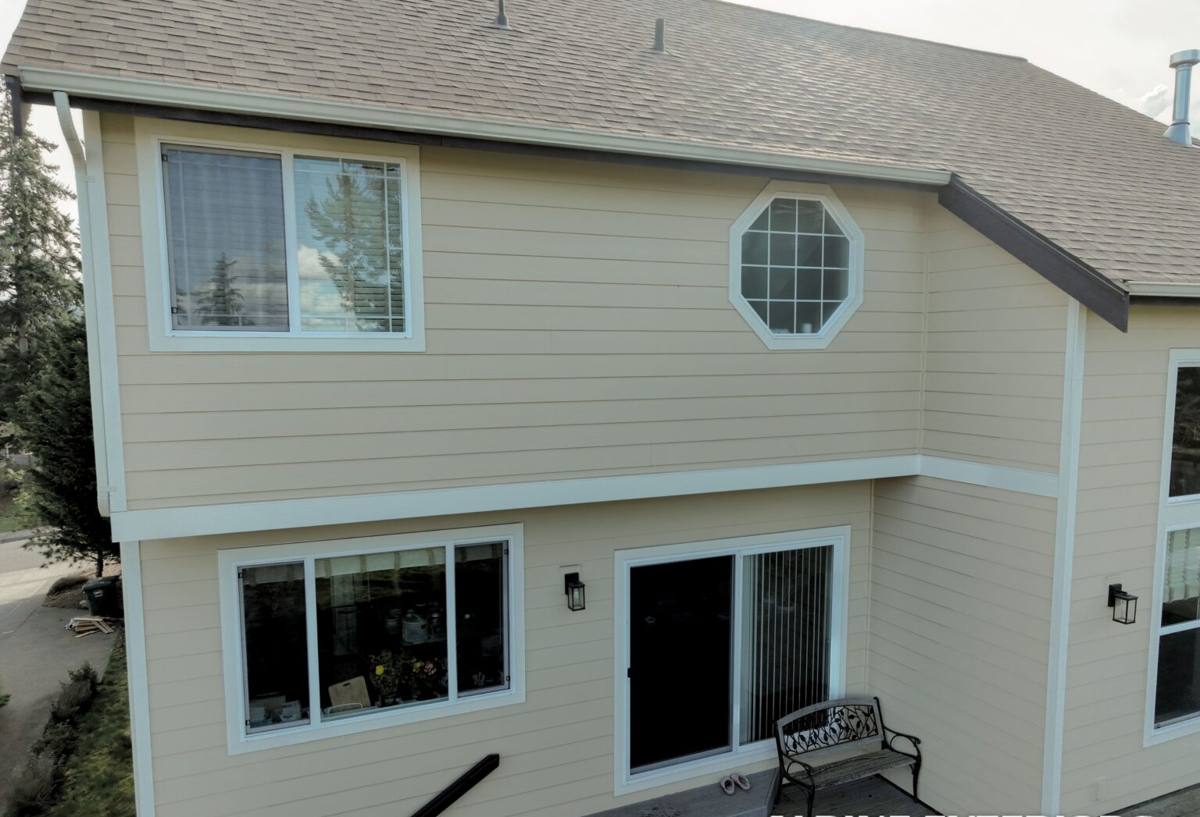
What a Lynden Installation Has to Stand Up To
Salt Air Working Its Way Inland
Lynden sits back from the immediate coastline, but marine air moves across this part of Whatcom County regardless of exact distance to saltwater. Over years, that air accelerates corrosion on fasteners, flashing, and lower-grade trim hardware. It's a slower process than at a shoreline property, but an installation that assumes a dry, inland climate and specs hardware accordingly is starting from the wrong assumption.
Driving, Wind-Pushed Rain
Fall and winter rain in this region doesn't fall straight down very often. Wind drives it sideways into wall assemblies, window trim, and the transitions where a roofline meets a wall. An installation has to account for that sideways load at every seam and penetration — it's the single biggest factor separating siding that keeps water out for decades from siding that starts leaking behind the cladding within a few wet seasons, no matter how good the material itself is.
A Moss Season That Doesn't Really End
Mild temperatures, tree cover, and near-constant moisture combine into a moss and mildew season that runs close to year-round on shaded siding. Lynden's mix of open agricultural land and tree-sheltered residential lots means this varies a lot from house to house — a wall facing open field dries fast after rain, while a wall shaded by mature trees can stay damp for days. Installation decisions, like how much clearance siding gets above grade and how tightly panels are sealed at joints, directly affect how much of a foothold moss and mildew get.
What "Correct Installation" Actually Involves
This is the part most homeowners never see broken down, and it's the part that matters most. A siding installation isn't just fastening panels to a wall — it's a layered system, and each layer has to be done right for the whole assembly to perform.
The Weather-Resistive Barrier Comes First
Before any siding goes up, a weather-resistive barrier goes over the sheathing. Its job is to stop any water that gets past the siding from reaching the wood structure underneath. Seams have to be lapped correctly — upper courses over lower courses, following gravity — and taped or sealed at every joint. A barrier installed with reversed laps or gaps at penetrations defeats the purpose even if it looks fine once covered.
Flashing at Every Penetration
Windows, doors, vents, hose bibs, light fixtures — every point where something passes through the wall plane is a place water can get in behind the siding. Correct flashing directs water back out and over the weather barrier rather than letting it collect behind the cladding. This is the step that's easiest to rush and hardest to catch once siding is up, which is exactly why it deserves the most attention, not the least.
Fastening and Clearances
James Hardie's warranty is tied to following their published installation specs — correct fastener type, spacing, and depth, plus minimum clearances above grade, roofline, and decks or patios. Fastening too tight or too loose, or skipping required clearances to save a few inches of material, is exactly the kind of shortcut that voids warranty coverage and shows up as a problem years later.
Field Cuts, Caulking, and Butt Joints
Every panel that gets cut on-site needs the cut edge properly sealed, since raw fiber cement edges are more vulnerable to moisture intake than factory-finished faces. Butt joints between panels need the right gap and sealant, not a tight, caulk-free seam that has nowhere to move as temperature changes the material dimensionally. These are small details individually, but they're the details that separate an installation that ages well from one that starts showing hairline cracking and staining at the joints within a few years.
Why the Installation Standard Is James Hardie Fiber Cement
We install James Hardie fiber cement exclusively. We don't install LP SmartSide, vinyl siding, Cemplank, Allura, primed spruce, or cedar. That's a professional standard we've settled into after years of doing installation work in this climate, not a sales position — each of those products has a legitimate place in the market, and plenty of homeowners are satisfied with them elsewhere. Our reasoning is specific to what holds up against sustained coastal moisture, salt exposure, and a long wet season.
- Non-combustible core: Fiber cement doesn't feed a fire the way wood-based siding products can, which matters for both safety and insurance underwriting.
- Factory-applied ColorPlus finish: Baked on under controlled conditions rather than field-applied, holding color and adhesion far longer under sustained UV and moisture exposure.
- Climate-engineered HZ product lines: Hardie's HZ5 formulation is built for regions with significant moisture exposure and freeze-thaw cycling, which describes Lynden and the rest of northern Whatcom County well.
- Dimensional stability: Fiber cement resists the swelling, cupping, and warping that engineered wood siding can develop after repeated wetting cycles.
- A strong transferable warranty: Backed by Hardie, provided installation follows their published specifications — which is exactly why the installation details above aren't optional extras.
| Product | Installation-related trade-off in this climate |
|---|---|
| Vinyl siding | Panel gaps and seams designed to allow thermal movement can also give wind-driven rain a path in if not detailed carefully |
| LP SmartSide / engineered wood | Wood-strand core is more sensitive at cut edges and fastener points, making field-cut sealing even more critical than with fiber cement |
| Primed spruce or cedar | Correct installation still leaves an ongoing paint and moisture maintenance schedule that fiber cement doesn't require |
| Other fiber cement brands | May not offer the same climate-specific HZ formulation or factory-finish warranty depth as James Hardie |
How an Installation Project Runs, Step by Step
| Stage | What happens |
|---|---|
| Inspection and estimate | We look at current siding condition, signs of trapped moisture, and how sun, shade, and wind exposure differ across each wall of the house |
| Tear-off and sheathing check | Old siding comes off and the sheathing underneath gets inspected for rot or soft spots before anything new is installed over it |
| Weather barrier and flashing | House wrap and flashing go in at every seam and penetration — the layer that determines whether the assembly actually keeps water out |
| Siding installation to spec | Panels go up following James Hardie's fastening, spacing, and clearance requirements as the baseline, not an upgrade |
| Trim, caulking, and detail work | Field cuts get sealed, butt joints get proper gap and sealant, and trim is finished around windows, corners, and rooflines |
| Final walkthrough | We walk the completed job with the homeowner, cover maintenance expectations, and confirm the work matches the original estimate |
Every one of these stages depends on the one before it. Skipping the sheathing check to save a day, or rushing flashing to keep a crew on schedule, doesn't show up as a problem immediately — it shows up two or three wet seasons later, usually as staining or soft spots that trace back to a step that got shortcut during installation.
Permits and Timeline for a Lynden Job
Full siding replacement in Whatcom County generally requires a permit, and how long that takes depends more on the permitting office's current workload than on the job itself. We handle the permitting process as part of the project so homeowners aren't left tracking that down separately. Actual installation time on-site varies with house size, trim complexity, and what turns up once old siding comes off — a straightforward job moves faster than one where sheathing repair is needed, so we'd rather give an honest range during the estimate than a number that assumes everything goes perfectly.
What to Ask Before Hiring a Siding Installation Crew
- What specific product and product line do they install, and why that one
- Do they pull their own permits, or is that left to the homeowner
- How do they handle sheathing repair if rot is found during tear-off
- What fastener spacing and clearance standards do they follow, and are those documented
- Who's actually on the crew doing the work — subcontracted labor or their own installers
- What does their warranty cover, separate from the manufacturer's material warranty
A contractor who answers these specifically, rather than defaulting to a price quote, is generally the safer hire — installation quality is hard for a homeowner to verify after the fact, so the vetting has to happen before the work starts.
Signs an Existing Installation Is Starting to Fail
Not every issue means the siding material itself is bad — a lot of what we see traces back to installation details that weren't handled correctly the first time.
- Moss or dark staining that returns quickly after cleaning, especially on shaded walls
- Soft or spongy siding low on the wall or around window and door trim
- Cracking concentrated at butt joints or field-cut edges rather than across whole panels
- Peeling paint or visible warping, most common on older wood-based siding
- Rust streaking from fasteners or trim hardware
- Musty odors or interior staining on walls that back up to exterior siding
Cracking or staining that follows a pattern — always at joints, always on one wall orientation, always near a specific window — usually points to an installation detail rather than a material failure, and it's worth having someone look at the actual cause rather than just patching the visible symptom.
What Moves the Cost of a Lynden Siding Installation
Every estimate is specific to the house, but a few factors consistently move the number: total square footage and number of stories, how much trim and detail work surrounds windows and rooflines, the condition of the sheathing once old siding comes off, and which James Hardie product line and color fits the home. Complex rooflines and heavily trimmed facades take more labor per square foot than a simple, single-story wall, and that's usually the biggest swing factor beyond raw square footage.
If your Lynden home needs new siding, or you'd like an honest look at whether an existing installation was done to spec, we're glad to come take a look. Reach out using the form below for a free, no-pressure estimate.