 Bellingham
 Why Fairhaven Decks Wear Out Faster Than You'd Expect
Fairhaven sits right up against Bellingham Bay, and that waterfront location cuts both ways. It's part of what makes the neighborhood desirable, but it's also why decks here take more abuse than decks built the same year a few miles inland. Salt-laden air moves off the bay and settles into every exposed fastener, hinge, and joist hanger on a deck's structure. Combine that with the driving rain that comes through Whatcom County off the Strait, and you've got wood and hardware that are constantly cycling between wet and dry, salt and fresh.
Then there's moss. Bellingham's moss season isn't a few weeks — it's realistically October through May most years, and a shaded or partially covered deck can stay damp under a moss mat for days after a storm has passed. That trapped moisture is where rot starts, usually in places you can't see from a casual walk-around: under boards, inside ledger connections, around post bases.
None of this means Fairhaven decks are doomed. It means they need repairs that actually account for the local conditions, not a generic patch job that ignores what's really degrading the structure.
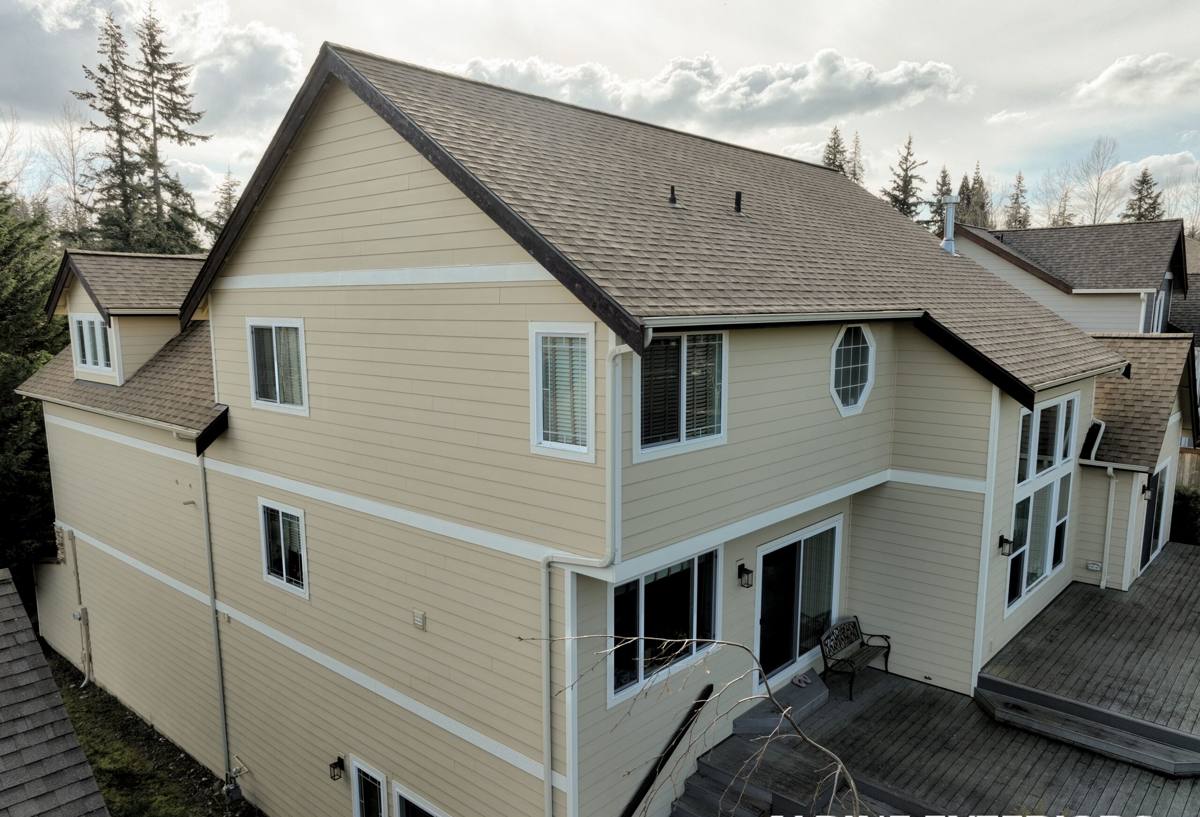
Signs Your Fairhaven Deck Needs Repair
Most deck problems start small and stay hidden until they're not. Here's what we tell homeowners to watch for between inspections:
- Soft or spongy spots when you walk across the decking, especially near the house or along the perimeter
- Green or black staining that keeps coming back within weeks of cleaning it off
- Gaps opening up between the deck and the house where the ledger board attaches
- Railings or stair posts that flex or wiggle more than they used to
- Rust streaks bleeding out from screw heads, joist hangers, or bolts
- Boards that have cupped, crowned, or started to split along the grain
- A musty smell coming from underneath the deck, particularly after rain
- Fasteners that back out on their own or spin freely without biting
Any one of these on its own might be minor. Two or three together, especially near a support post or the ledger connection, usually means it's time to have someone look underneath, not just at the surface.
What's Actually Failing: The Problems We Find Most Often
Ledger Board and Structural Connections
The ledger board — where the deck attaches to the house — takes on more water exposure than almost any other part of the structure, especially if flashing was installed poorly or has failed over time. In a climate that gets consistent driving rain, water can work its way behind the ledger and sit there unnoticed. By the time it shows up as a soft spot or a stain on the siding above, there's often already rot in the framing.
Fastener and Hardware Corrosion
Salt air accelerates corrosion on anything metal, and a lot of older decks in this area were built with standard galvanized hardware that just isn't rated for a coastal environment. Once fasteners start rusting, they lose holding strength long before they look obviously bad. We see this most on joist hangers, post bases, and structural screws — the parts doing the real load-bearing work.
Moss, Algae, and Surface Decay
Surface-level moss and algae are more than a slip hazard. They hold moisture against the wood fibers or composite surface for extended periods, which speeds up graying, splintering, and — on wood decks — actual fiber breakdown. On composite decking, trapped moisture under leaves or debris can also promote mold growth on the surface, which is a maintenance issue rather than a structural one, but it's often the visible warning sign of a deck that isn't shedding water the way it should.
Railing and Stair Safety
Railings and stair stringers get less attention than decking boards but carry real safety consequences when they fail. Loose railing posts are usually a sign that the fasteners or the wood around them have degraded, and it's one of the first things we check because it's a life-safety issue, not just a cosmetic one.
Repair or Replace? How We Make That Call
Not every damaged deck needs to come out. A lot of decks are structurally sound with isolated problem areas — a rotted ledger connection, a handful of failing boards, a couple of corroded hangers — that can be repaired properly without rebuilding the whole thing. Others have enough cumulative damage that patching individual spots would just mean redoing the same work again in a couple of years. Here's generally how that decision breaks down:
| Factor | Favors Repair | Favors Replacement |
|---|---|---|
| Extent of rot | Isolated to a few boards or one framing member | Spread across multiple structural members |
| Age of structure | Under 15-20 years, built to a reasonable standard | Original construction is old, undersized, or non-compliant |
| Ledger condition | Solid, properly flashed | Rotted, poorly flashed, or attached incorrectly |
| Fastener condition | Mostly sound with a few corroded spots | Widespread rust and failing connections |
| Footings/posts | Stable, no movement or heaving | Settling, cracking, or undersized for current code |
| Your plans | Keeping the current layout and size | Wanting a different footprint, level change, or added features |
We'll always tell you honestly which category your deck falls into after we've actually gotten underneath it and checked the framing, not just looked at the decking surface. A deck that looks rough on top can have a perfectly sound structure underneath, and one that looks fine on top can be hiding real problems below.
Our Deck Repair Process
A repair done right starts before we touch a single board. Here's how we approach it:
- Full inspection from below and above. We check the ledger connection and flashing, joists, post bases, footings, and every visible fastener, not just the deck surface.
- Moisture and rot mapping. We probe suspect areas to find the actual boundary of the damage rather than guessing where it stops.
- Honest scope discussion. We walk you through what we found, what needs to be replaced versus what can stay, and what it will cost — before any work starts.
- Removal of damaged material. We cut back to solid wood and remove any hardware that's corroded or undersized for the load it's carrying.
- Structural correction. This is where ledger flashing gets redone properly, undersized or corroded hardware gets upgraded, and any framing that's out of compliance gets brought up to a proper standard.
- Rebuild and refasten. New boards, hardware, and connections go in matched to the existing structure where possible, or upgraded where the original approach wasn't holding up.
- Final check and homeowner walkthrough. We test railings, stairs, and the repaired sections before we consider the job done, and we explain what maintenance will keep it in good shape going forward.
Material Choices When We Rebuild Sections
When a repair involves replacing boards or framing, the material choice matters more in this climate than it would somewhere drier. Here's how the common options generally compare for repair work:
| Material | Moisture Behavior | Maintenance Needed | Typical Use in Repairs |
|---|---|---|---|
| Pressure-treated lumber | Resists rot when properly sealed; can still cup or check | Periodic sealing/staining | Framing and structural repairs, budget-conscious decking |
| Cedar | Naturally rot-resistant, but surface grays without maintenance | Regular sealing to hold color and resist moisture | Decking boards where wood appearance matters |
| Composite decking | Won't rot, but can trap moisture and grow mold on the surface if not cleaned | Periodic cleaning, minimal sealing | Decking surface replacement, especially in shaded areas |
For any framing repair, we use fasteners and hardware rated for the moisture and corrosion exposure the deck actually faces — that's a non-negotiable for us given how much salt air accelerates hardware failure here. Using standard hardware to save a few dollars just means paying for the same repair again sooner than you should have to.
Keeping Moss and Rot From Coming Back
A good repair buys you time, but this climate doesn't stop working on your deck once the crew leaves. A few habits make a real difference in how long a repair lasts:
- Sweep debris and organic matter off the deck regularly, especially in shaded corners where moss establishes first
- Keep gutters and downspouts clear so water isn't dumping directly onto or under the deck
- Reseal or restain wood decking on the schedule appropriate for the product — usually every 1-3 years depending on sun and shade exposure
- Check under the deck once or twice a year for standing water, soft framing, or new staining
- Address small issues — a loose board, a rusting screw head — before the next wet season rather than after
None of this is complicated, but it's the difference between a repair that holds for a decade and one that starts failing again in three or four years.
Why Local Experience in Fairhaven Matters
A contractor who mostly works drier, inland areas can still do competent carpentry, but they won't necessarily know to double-check flashing details that matter more with driving rain, or to spec hardware rated for salt exposure, or to expect moss buildup in spots that would stay dry elsewhere in Whatcom County. Working regularly in and around Fairhaven and greater Bellingham means we're used to the specific failure patterns this environment produces, and we know what actually holds up here versus what looks fine on paper.
We're also familiar with the practical side of working in an established waterfront neighborhood — being mindful of neighboring properties, working around mature landscaping, and coordinating access on lots that weren't designed with modern construction equipment in mind. It's a small thing, but it affects how smoothly a repair project actually goes.
If you've got a deck in Fairhaven that's showing any of the warning signs above, we're glad to come take an honest look and tell you exactly what we find — no pressure, no inflated scope. Fill out the form below for a free estimate.