 Bellingham
 Ferndale's Climate Is Harder on Siding Than It Looks
Ferndale sits close enough to Bellingham Bay and the Salish Sea that salt-laden air is a constant, low-grade stress on anything mounted to the outside of a house. Add in the driving rain that comes through Whatcom County during fall and winter storm systems, and a long stretch of the year where shaded walls and north-facing exposures barely dry out, and you've got a climate that's genuinely tougher on siding than most homeowners realize. It's not dramatic — no hurricanes, no hail the size of golf balls — it's persistent. Persistent moisture, persistent salt exposure, and a moss and algae season that can run six months or longer on the wrong exposure.
That combination punishes siding materials differently than a dry inland climate would. Wood siding that would hold up fine in eastern Washington rots here. Vinyl that looks fine in a showroom chalks, warps, and grows a green film on shaded elevations. Caulk joints that would last a decade elsewhere fail in half that time under constant wet-dry cycling. None of this is a knock on Ferndale — it's just what a marine climate does, and it's exactly why the siding material and the installation details matter more here than in most parts of the country.
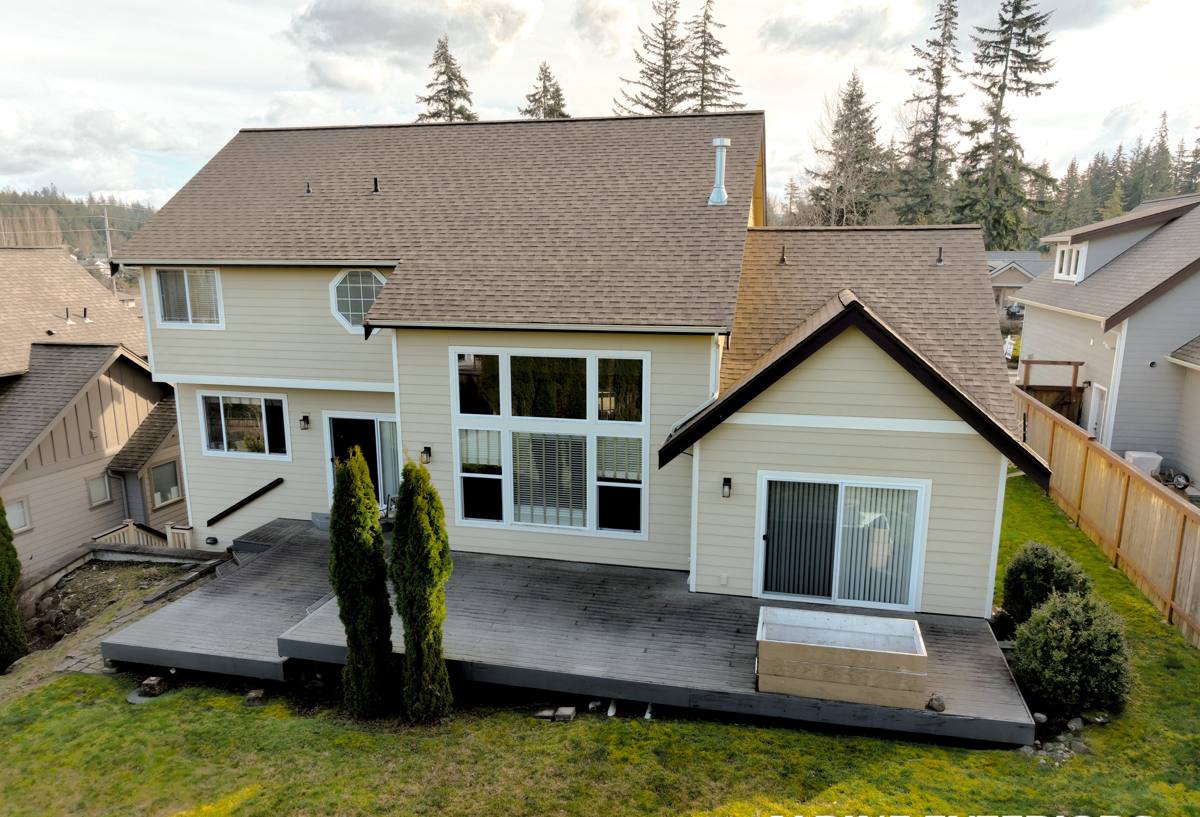
Why We Only Install James Hardie in This Climate
Engineered for the Pacific Northwest
James Hardie makes region-specific formulations of its fiber cement products, and the HZ5 line is engineered for climates like ours — places with sustained moisture, moderate freeze-thaw activity, and salt air. That's not a marketing footnote; it affects the actual composition of the board. A siding product that wasn't built with this weather pattern in mind is starting the fight from behind before a single nail goes in.
A Factory Finish Instead of a Field Paint Job
ColorPlus, Hardie's factory-applied finish, matters more here than in a dry climate. Field-applied paint on siding has to fully cure in ambient conditions, and in a place where humidity sits high for much of the year, that cure window is unreliable. A factory-baked finish goes on under controlled conditions and simply performs more consistently over the following years — better fade resistance, better adhesion, and a much longer stretch before a homeowner is looking at a repaint.
Non-Combustible, for What It's Worth
Wildfire isn't the primary driver for choosing fiber cement in Whatcom County the way it is in drier parts of the state, but it's still a real property protection consideration worth knowing about. Fiber cement doesn't feed a fire the way wood-based siding products can, and that's a permanent feature of the material, not something that fades with age.
What a Correct Installation Involves Here
Fiber cement siding is only as good as the installation underneath it, and in a wet climate the details that get skipped on a rushed job are exactly the ones that cause problems later.
Weather-Resistive Barrier and Flashing
Everything starts behind the siding. A continuous weather-resistive barrier, properly lapped and taped, and correct flashing at every window, door, and roofline penetration is what actually keeps water out of the wall assembly — the siding itself is the second line of defense, not the first. Kick-out flashing where a roofline meets a sidewall is a detail that's easy to skip and expensive to ignore; without it, water runs directly down behind the siding at that junction.
Nailing and Fastening
Hardie's installation manual specifies fastener type, spacing, and placement, and those specs exist because incorrect fastening is one of the most common causes of siding failure — cracked boards, blow-off in wind events, and water intrusion at over-driven or under-driven nail heads. There's no substitute for following the manufacturer's nailing pattern board by board.
Clearances and Expansion Gaps
Fiber cement needs proper clearance from grade, roofing, decks, and other siding boards, and it needs small gaps at butt joints and trim to accommodate expansion and contraction. Installing it tight against another surface, or letting it sit too close to soil or a roof deck, invites the kind of moisture wicking that shows up as swelling or deterioration years down the road — long after the crew that did the rushed version is gone.
Caulking That's Built for Wet-Dry Cycling
Not all caulk is created equal, and in a climate that cycles between soaked and dry constantly, using the wrong sealant at joints and penetrations is a slow-motion failure. The right product, applied at the right joints — and not over-relied on to compensate for poor flashing — is part of doing this correctly the first time.
Our Process on a Ferndale Job
- Assessment. We look at the existing siding, the condition of the sheathing underneath where visible, and any signs of past moisture intrusion — trouble spots common on homes that have weathered a lot of Whatcom County winters.
- Tear-off and sheathing check. Removing the old siding is also when hidden problems surface. If sheathing has been compromised by long-term moisture, that gets addressed before anything new goes up — covering rot with new siding just hides the problem.
- Weather barrier and flashing installation. This is the step that determines whether the house stays dry for the next several decades, and it's not one we shortcut to save time.
- Hardie installation to manufacturer spec. Fastening, spacing, clearances, and joint treatment all follow James Hardie's documented installation requirements — not a generic "how we've always done it" approach.
- Trim, caulking, and finish work. Final detailing at corners, windows, and transitions, using sealants suited to this climate.
- Walkthrough. We go over the finished job with the homeowner before calling it done.
Comparing Siding Options for a Wet, Salt-Air Climate
Every siding material handles this climate differently. Here's an honest comparison across the factors that actually matter in Whatcom County conditions.
| Material | Moisture Behavior | Moss/Algae Resistance | Maintenance | Typical Lifespan |
|---|---|---|---|---|
| James Hardie fiber cement | Engineered for this climate (HZ5); dimensionally stable when installed correctly | Factory finish resists staining better than raw wood; still benefits from periodic cleaning | Low — occasional wash, inspect caulk lines | Multiple decades with correct install and care |
| Vinyl siding | Can warp or bow under repeated wet-dry and temperature swings | Grows algae film readily, especially on shaded walls | Low effort but limited repair options if damaged | Shorter than fiber cement; UV and cold can shorten it further |
| Cedar or primed wood | Absorbs moisture; prone to rot without diligent upkeep | Highly susceptible to moss and mildew in shaded, damp conditions | High — regular refinishing and sealing required | Shortest of the group without aggressive maintenance |
| LP SmartSide (engineered wood) | Wood-based core is more moisture-sensitive than fiber cement | Better than raw cedar but still needs careful edge sealing | Moderate — edge and cut-end sealing is critical | Shorter than fiber cement; installation quality matters heavily |
Signs Your Ferndale Home May Need New Siding
- Soft or spongy spots when you press on the siding, especially near the bottom courses or below windows
- Persistent moss, algae, or black streaking that comes back quickly after cleaning
- Paint that's peeling, bubbling, or failing faster than it should
- Visible warping, buckling, or gaps opening up between boards
- Rising heating bills that suggest the wall assembly isn't performing the way it used to
- Cracked or missing caulk at joints, trim, and penetrations
- Interior signs like musty smells or discoloration on walls that share an exterior wall
Why a Local Crew That Already Works Ferndale Matters
Siding installation isn't generic — a crew that's used to installing in a dry, low-humidity region is going to make different assumptions than one that works Whatcom County year-round. Knowing how long a wall assembly needs to dry between steps, how aggressive the moss growth gets on a shaded north wall, and how the local housing stock was built across different eras all shape the decisions made on a job.
There's also the practical side: a crew based near Bellingham can respond quickly if a warranty question or a minor issue comes up after the job is done, without a homeowner waiting on a company that's really just passing through the area. Local reputation only holds up if the work holds up, which is its own kind of accountability.
Living With Fiber Cement Siding in a Moss-Prone Climate
Even the right material and a correct installation benefit from a little ongoing attention in this climate. Keeping gutters clear so water isn't sheeting down the siding, trimming back vegetation and tree cover that keeps a wall perpetually shaded and damp, and doing an occasional gentle wash on north-facing or heavily shaded elevations go a long way toward keeping moss and algae from taking hold. It's worth periodically checking caulk lines at trim and penetrations too — sealant is the one part of the system that wears out well before the siding itself does, and catching a failed joint early is a lot cheaper than dealing with what happens if it goes unnoticed for a few wet seasons.
If you're weighing your options for a Ferndale home, we're happy to take a look and give you a straightforward, no-pressure estimate — no invented urgency, just an honest read on what your siding needs and what correct James Hardie installation would look like on your house.